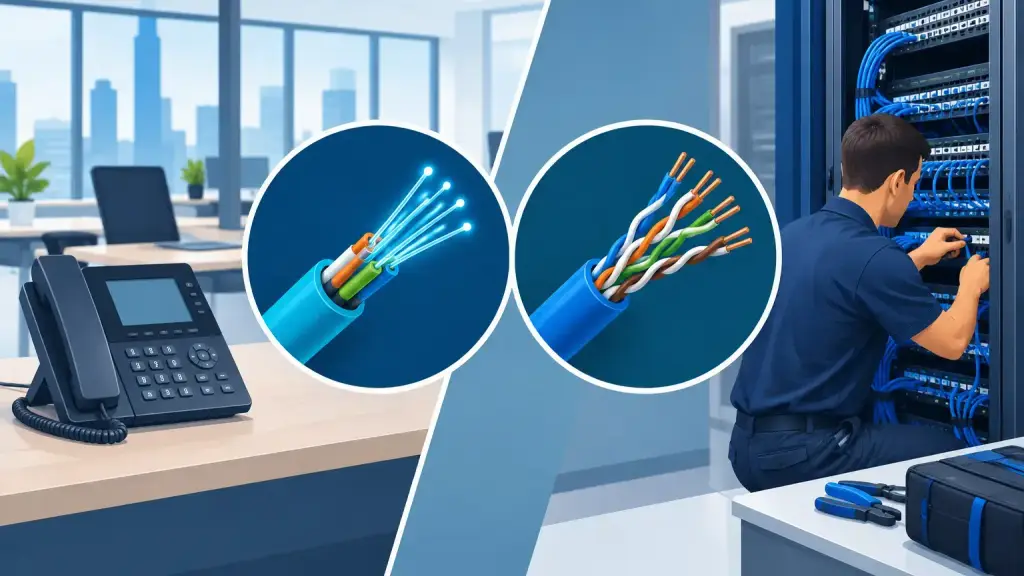
A phone system relocation, office expansion, or recurring cabling failure can force a decision that is more complicated than it first appears: fiber versus copper voice cabling. Fiber is faster over long distances and highly resistant to interference. Copper remains the practical connection for many business phones, legacy PBX stations, and devices that need power at the endpoint.
The right answer is rarely fiber everywhere or copper everywhere. It depends on what equipment you operate, how far signals must travel, whether you are supporting an older phone platform or hosted VoIP, and what the building will need next.
Fiber Versus Copper Voice Cabling: The Real Difference
Fiber carries information as pulses of light through glass strands. Copper carries electrical signals through metal conductors. That basic difference affects distance, power delivery, installation methods, testing, repair options, and the equipment required at each end.
For a business voice environment, fiber is usually part of the network backbone. It connects network closets, floors, buildings, or distant equipment rooms. Copper typically runs from a telecom closet to the phone, workstation, wall jack, access point, or other endpoint.
This distinction matters because a fiber cable cannot connect directly to a traditional analog telephone or a proprietary digital PBX handset. Fiber needs active equipment, such as switches, media converters, or voice gateways, to convert the signal for the equipment in use. Copper may connect directly to the phone system and station equipment, depending on the system design.
Where Copper Still Makes Sense for Business Phones
Copper is not outdated simply because fiber is available. For many offices, it is still the correct and cost-effective cabling medium at the desk.
Legacy PBX station wiring
Older PBX systems from manufacturers such as Panasonic, Nortel, Avaya, NEC, and Vodavi may use analog lines, digital station ports, proprietary phone connections, or a mix of these. These systems were designed to operate over copper cabling. Replacing existing station wiring with fiber will not automatically improve call quality or add features. In many cases, it adds conversion equipment and unnecessary points of failure.
The first question should be whether the existing cable is in good condition and compatible with the phone system. A technician can test pairs, identify shorts or opens, verify termination, and determine whether a cabling issue is causing dropped calls, dead extensions, or intermittent phone behavior.
VoIP phones at the desktop
Most IP phones connect with Category 5e, Category 6, or similar copper Ethernet cabling. This connection can carry voice data and Power over Ethernet, or PoE, on the same cable. That means the phone can operate without a separate power adapter when the network switch provides PoE.
This is a major practical advantage. A fiber connection at every desk would still require local electrical power or additional equipment to serve the phone. For standard office work areas, copper Ethernet remains simpler to install, easier to move, and easier for a technician to troubleshoot.
Short-distance runs and existing infrastructure
Copper is well suited for ordinary horizontal runs from a telecommunications room to offices, reception areas, conference rooms, and workstations. If the route is within standard Ethernet distance limits and the cable is properly installed and tested, it can reliably support voice, data, and PoE devices.
For an established office, reusing sound copper infrastructure can reduce disruption. The decision should be based on test results, cable type, condition, pathway capacity, and the requirements of the planned phone and network equipment - not on the assumption that newer always means better.
Where Fiber Is the Better Choice
Fiber becomes more valuable as distance, bandwidth, electrical interference, and growth requirements increase. Its strongest role is usually between infrastructure points, not directly at the handset.
Between telecom closets and floors
A multi-floor building may have an equipment room on one floor and network closets elsewhere. Fiber can connect those closets without the distance and bandwidth constraints of copper Ethernet uplinks. Each local closet can then distribute copper cabling to phones and workstations nearby.
This design keeps the endpoint wiring practical while giving the business a high-capacity backbone. It also makes future changes easier when more users, IP phones, wireless devices, cameras, or cloud-based applications are added.
Between separate buildings
Copper cabling between buildings can create problems from electrical potential differences, lightning exposure, and grounding issues. Fiber is nonconductive, which makes it the preferred choice for many inter-building connections. Proper pathway design and termination still matter, but fiber avoids carrying electrical current from one structure to another.
For organizations with a main office, warehouse, detached office, or campus-style layout, this can be a significant reliability and safety consideration.
High-interference industrial or commercial areas
Electrical noise can affect copper cabling, particularly where cable routes run near heavy machinery, motors, elevators, transformers, or industrial equipment. Fiber does not have the same susceptibility to electromagnetic interference.
That does not mean every business near electrical equipment needs fiber to every phone. It means the backbone and route design deserve careful review when interference is a credible issue. In some cases, rerouting or using properly rated copper cable is enough. In others, fiber is the better long-term choice.
Call Quality Is Not Determined by Fiber Alone
A common misconception is that fiber automatically improves phone call quality. For a voice system, call quality depends on the entire path: phone equipment, PBX or hosted platform, network configuration, switch capacity, PoE availability, internet connection where applicable, quality-of-service settings, and the condition of the cabling.
A fiber backbone can support more network traffic and reduce bottlenecks, which may help a busy VoIP environment. But installing fiber while leaving an overloaded switch, poorly configured network, failing PBX card, or damaged station cable unresolved will not fix the real problem.
Likewise, a legacy PBX can provide dependable internal and external calling over properly maintained copper wiring. If the business is satisfied with its features and the system remains supportable, a targeted repair or cabling correction may be the most sensible course of action.
Plan Around the Phone System You Have and the One You May Need
The cabling decision should support your operating plan. A business that expects to retain a legacy PBX for several years has different priorities from one preparing for a hosted VoIP migration, office consolidation, or multi-site expansion.
For legacy systems, identify the exact phone system model, extension types, existing cable pairs, and any problem areas before changing wiring. Some proprietary phones require specific ports and wiring arrangements. A generic cabling approach can create avoidable service interruptions.
For hosted VoIP, assess switch capacity, PoE needs, available network drops, internet reliability, battery backup, and how calls will be handled during an outage. Copper to the desk and fiber between network rooms is often an effective design, but the final layout should match the building and the number of active users.
If you are renovating, it is often wise to install additional pathway capacity and spare cabling while walls and ceilings are accessible. The extra preparation can prevent a costly disruption when offices are reconfigured later.
Common Mistakes to Avoid
The most expensive cabling decisions often come from treating voice, data, and power as separate issues. They are connected. A new IP phone may need an available Ethernet port, PoE from the switch, the correct VLAN configuration, and a tested cable run. A new fiber uplink may require compatible optics, patch panels, labeling, and equipment at both ends.
Avoid assuming that old cable is unusable or that new cable is automatically installed correctly. Cable age alone does not determine performance, and newly installed cabling still needs proper termination and certification. Clear labeling is equally important. During an emergency, a well-labeled closet can save valuable time tracing a failed extension or uplink.
Also avoid replacing cabling before diagnosing the fault. A dead phone can be caused by a failed handset, a bad station port, damaged cable, programming changes, loss of power, a failed network switch, or an outside service issue. Accurate diagnosis protects both uptime and budget.
A Practical Recommendation for Chicago-Area Businesses
For most offices, use fiber where it delivers a clear infrastructure benefit: between floors, network closets, buildings, or long-distance equipment locations. Use quality copper cabling where phones and powered network devices connect at the endpoint. Preserve and test compatible legacy station wiring when it is serving the business reliably.
iTeleco helps Chicago-area businesses assess existing PBX wiring, repair cabling faults, support legacy phone systems, and plan practical transitions to hosted VoIP when the time is right. The goal is not to replace working infrastructure for its own sake. It is to keep communications dependable while making upgrades that solve a real operational need.
Before committing to either medium, document the equipment, cable routes, power requirements, and future expansion plans. A cabling design that fits the building and the phone system will prevent more downtime than a one-size-fits-all upgrade ever will.