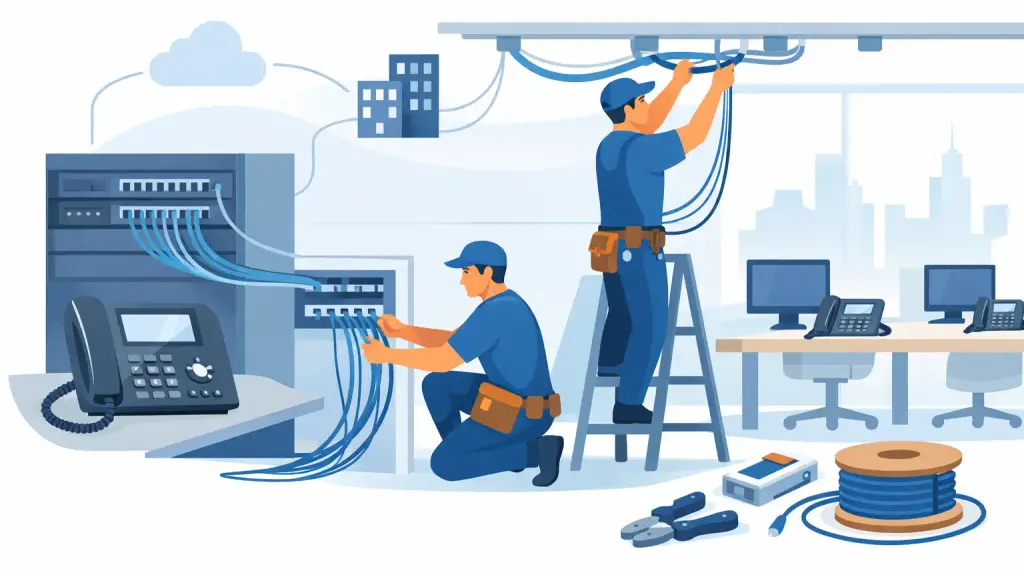
When a business phone system starts dropping calls, crackling, or failing to ring where it should, the phone hardware often gets blamed first. In many cases, the real problem is the wiring behind the walls, above the ceiling, or inside an aging telecom closet. That is why business phone cabling installation matters more than most offices realize. If the cabling is poorly planned or installed on top of older, undocumented wiring, even a good phone system will perform like a bad one.
For office managers, IT leaders, and business owners, cabling is not the flashy part of a telecom project. It is the part that either supports reliable daily operations or creates years of service calls. A proper installation gives you clean signal paths, organized cross-connects, easier troubleshooting, and room to grow. A rushed job usually leaves you with mislabeled runs, mystery jacks, and downtime that hits customer service and sales.
What business phone cabling installation actually includes
Business phone cabling installation is more than pulling a few lines to desks. It usually starts with a site review that looks at the layout, user count, phone system type, and the condition of any existing wiring. From there, the installer determines whether the current cabling can be reused, partially reused, or needs replacement.
In a traditional PBX or key system environment, cabling may include station wiring to handsets, backbone cabling between telecom rooms, patch panels, 66 blocks or 110 blocks, demarc extension work, and proper labeling throughout. In a hosted VoIP setup, the phone service may ride on structured cabling that also supports the data network. That sounds simpler, but it raises the stakes because voice quality now depends on how well the cabling and network are designed together.
For many Chicago-area businesses, the reality is mixed infrastructure. An office may still rely on a legacy Panasonic, Nortel, Avaya, Vodavi, or NEC system in one part of the building while another department has moved to IP phones. That kind of environment requires practical judgment, not guesswork. Reusing existing cable can save money, but only if the cable type, condition, and termination quality support the application.
Why bad cabling causes expensive problems
Poor cabling work rarely fails all at once. It tends to create recurring issues that waste time and frustrate staff. One extension might work intermittently. Another might pick up noise. A move to a new desk may require tracing unlabeled pairs for an hour. In a busier office, that turns into lost productivity very quickly.
The cost is not just technical. Missed calls affect front-desk coverage, scheduling, dispatch, client intake, and internal coordination. If your phones are tied to revenue or service response, every avoidable outage has a business cost. That is especially true in professional offices, healthcare settings, warehouses, and multi-location operations where consistent call handling is part of the workflow.
Bad installations also make future changes harder. If the original cabling is undocumented or terminated inconsistently, every adds, moves, and changes request becomes more expensive. Clean installation pays for itself over time because it lowers the labor needed to support the system later.
Planning a business phone cabling installation the right way
The best installations start with business needs, not just cable counts. A small office with ten users has very different requirements than a growing company with call routing, paging, conference rooms, door phones, and plans for expansion. The wiring plan should reflect how the business actually uses its phones.
A proper review should account for workstation locations, reception needs, conference room connectivity, common-area phones, fax lines if still required, overhead paging, and alarm or elevator line considerations where applicable. It should also consider whether the business is keeping a legacy PBX, relocating an existing system, or preparing for a hosted VoIP transition.
This is where a lot of projects go sideways. Businesses sometimes assume that if a jack exists, it can support whatever phone service they want next. Sometimes that is true. Sometimes it is not. Older cable may be damaged, spliced, poorly terminated, or simply not rated for the application. A real assessment saves money because it prevents installing around hidden problems.
Reuse or replace? It depends on the site
Not every project needs a full rip-and-replace. If the existing cabling is in good condition and properly terminated, parts of it may be usable. That can make sense in buildings with solid legacy station wiring and a phone system that is staying in place.
But there are trade-offs. Reusing old cable may reduce upfront cost while increasing the chance of future troubleshooting. Replacing cable costs more at the start, but it often provides better reliability, cleaner records, and an easier path to upgrades. The right decision depends on building condition, business tolerance for risk, and how long the current phone platform is expected to remain in service.
Legacy systems need cabling support too
There is a common assumption that older PBX systems should not receive cabling investment because they will eventually be replaced. In practice, many businesses still depend on legacy platforms every day and need them working reliably now. If the system is stable and meets operational needs, cleaning up the cabling can extend its useful life and reduce repair calls.
That is especially relevant for businesses running established systems from Panasonic, Nortel, Avaya, Vodavi, or NEC. These platforms often serve companies well for years, but their performance still depends on the physical layer. Re-terminating bad pairs, replacing damaged runs, organizing punch blocks, and documenting extensions can make a major difference without forcing an immediate migration.
For companies considering a future move to hosted VoIP, cabling work can also be phased. That allows the business to stabilize current service first while preparing parts of the site for newer technology over time. A staged approach is often more practical than trying to overhaul everything at once.
What a professional installation should deliver
A quality installation is noticeable even after the technicians leave. Jacks are labeled clearly. Telecom rooms are organized. Patching is logical. Documentation exists. Moves and changes are manageable instead of chaotic.
Just as important, the installer should understand the phone system connected to the cabling. That matters because telecom work is not only about cable pathways. It involves extension assignments, line appearances, punch-down standards, demarc coordination, and testing that reflects real business use. If someone can pull cable but cannot support the system architecture behind it, problems get missed.
Professional work also means thinking past day one. If your office may add staff, relocate departments, or integrate newer voice services later, the installation should allow for that. Building in capacity and keeping records current is far less expensive than reworking a site every time the business changes.
Business phone cabling installation for relocations and expansions
Office moves are one of the most common times cabling mistakes happen. Timelines are tight, multiple vendors are involved, and telecom often gets treated like a last-minute item. Then move-in day arrives and phones are not ringing at reception, conference rooms are dead, and extension mapping does not match the floor plan.
During a relocation or expansion, cabling needs to be coordinated with furniture placement, internet service, power, and the phone system itself. The earlier that planning happens, the fewer surprises there are later. This is particularly important for businesses that are relocating existing PBX equipment or operating across multiple suites or floors.
For companies in Chicago and surrounding suburbs, local support can make a big difference during these projects. A provider that understands both legacy business phone systems and current VoIP requirements can help avoid the disconnect between cabling crews and phone vendors. That is a practical advantage when deadlines are tight and downtime is not acceptable.
Iteleco.com provides business phone cabling installation, legacy PBX support, and upgrade guidance for businesses in Chicago and surrounding suburbs. If your office is dealing with unreliable wiring, a phone room that has become unmanageable, or a move that needs to be done correctly the first time, call (773-340-7777). With 24/7 emergency support and hands-on experience across older and newer platforms, the goal is simple: keep your business communications working without unnecessary disruption.
The right cabling job is the one you do not have to think about again every few months. When the wiring is planned well, labeled clearly, and installed for the system you actually use, your phones stop being a recurring problem and go back to doing their job.