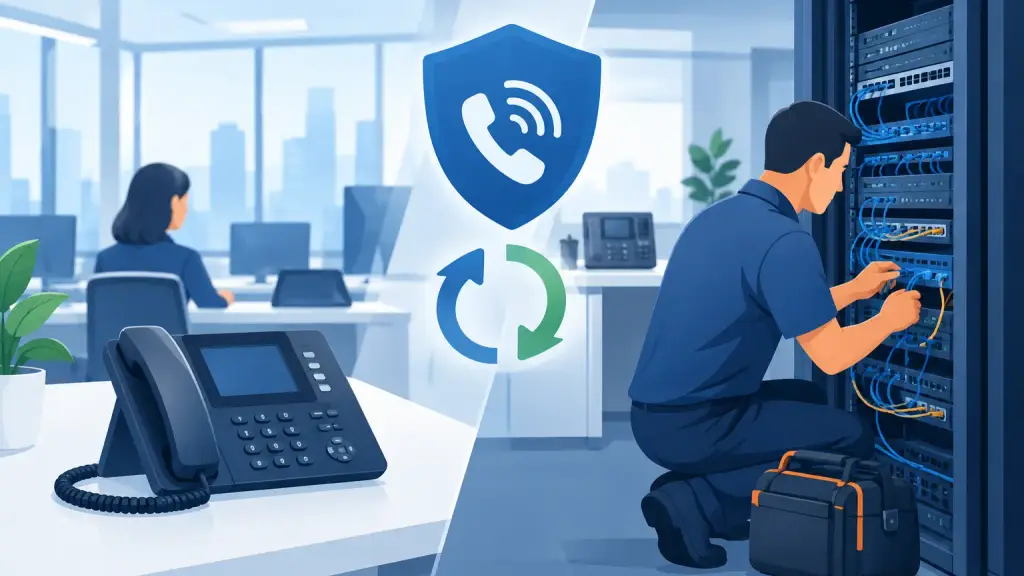
When a PBX fails at 8:15 a.m., the real problem is not the hardware. It is the unanswered customer calls, delayed dispatches, unavailable staff, and office teams forced to work around a communication outage. A useful PBX maintenance comparison looks beyond a provider’s general service claims and asks a more practical question: who can diagnose, repair, and support the exact system your business depends on when it matters?
For Chicago-area businesses still using Panasonic, Nortel, Avaya, Vodavi, NEC, and other established phone systems, maintenance decisions often come down to response capability, brand-specific knowledge, coverage scope, and a realistic plan for the future. The best fit is not always a full replacement. In many cases, the right maintenance partner can keep a reliable legacy PBX productive while helping the business plan a controlled transition to hosted VoIP when the time is right.
What a PBX Maintenance Comparison Should Measure
A maintenance agreement may sound similar on paper from one provider to another. The difference becomes clear when a failed station card, power supply, voicemail issue, trunk problem, or programming error interrupts business operations. Compare providers based on what they can actually do, not only what they say they cover.
Response time and emergency availability
Phone outages do not follow office hours. A provider that only accepts requests during standard business hours may be adequate for routine moves, adds, and changes, but it may not protect a business that takes orders, schedules service, handles urgent calls, or supports multiple locations.
Ask how emergency calls are handled, whether technical support is available 24/7, and what happens after the initial call. A fast acknowledgment is useful, but it is not the same as fast diagnostics or dispatch. Businesses should understand whether the provider can troubleshoot remotely, has technicians available for on-site service, and can respond when the issue involves wiring, cabinet hardware, carrier connections, or equipment that cannot be fixed from a distance.
Experience with your specific PBX platform
Legacy PBX systems are not interchangeable. A technician may understand business telephony in general yet lack the programming experience, replacement-part knowledge, or diagnostic process needed for a particular manufacturer and model.
That distinction matters when the issue is buried in a system’s configuration, voicemail integration, expansion cabinet, digital card, power unit, or proprietary handset connection. Brand-specific familiarity shortens the path from symptom to repair. It also reduces the risk of unnecessary replacement recommendations when the existing system can be restored.
For companies with older equipment, ask direct questions: Does the provider service this exact platform? Can it support common failure points? Does it have experience with programming, extensions, call routing, voicemail, and handset issues? A clear answer is more valuable than a broad claim of telecom experience.
Remote support versus on-site repair
Remote support is efficient for many problems. Changes to call forwarding, user programming, voicemail settings, and certain system configurations may be resolved without a truck roll. It can save time and help restore service quickly when the physical equipment is operating correctly.
However, remote support has limits. A dead controller, damaged cable, failed power component, disconnected circuit, or faulty station card requires hands-on work. A complete maintenance provider should be able to determine which type of response is needed and send a qualified technician when on-site service is the practical answer.
A PBX maintenance comparison should therefore include field-service capability. This is particularly important for businesses with older equipment, multiple closets, warehouse areas, detached offices, or infrastructure that has changed over time. The provider must be prepared to work with the real environment, not just the configuration screen.
Comparing Maintenance Coverage Before a Failure
Routine maintenance is not simply a repair plan waiting for something to break. It should reduce preventable disruption by identifying issues that tend to grow quietly: aging backup batteries, poorly labeled cabling, unreliable handsets, obsolete programming records, unused extensions, or a system cabinet without current documentation.
The scope of coverage should match how your organization uses the phone system. A small professional office may need dependable call handling and voicemail support. A service business may depend on immediate call routing, paging, dispatch phones, and after-hours coverage. A multi-location company may need consistent programming and accountability across several sites.
When reviewing service options, look for clarity around routine diagnostics, repair labor, programming changes, equipment replacement coordination, cabling support, user assistance, and emergency response. Vague coverage creates uncertainty during an outage. Clear expectations make it easier for office managers and IT leaders to act quickly.
Parts availability and repair judgment
A provider should be honest about the condition of aging hardware. Some components remain practical to repair or replace. Others may be difficult to source, have recurring reliability problems, or no longer make operational sense for a growing business.
That does not mean every older PBX should be replaced. Many organizations continue to operate legacy systems effectively with proper maintenance and access to skilled repair support. The key is judgment. Your provider should explain the condition of the equipment, the likely risks, and the reasonable options without forcing a premature migration.
A good maintenance relationship includes contingency planning. If a critical component fails, the business should know whether repair is feasible, whether a compatible replacement is available, and what temporary measures may keep calls moving. This preparation is especially valuable for systems that have been in place for years without updated documentation or a tested recovery plan.
Programming and user support
A phone system can be technically operational and still create daily frustration. Extensions may be assigned incorrectly, calls may ring to the wrong department, voicemail greetings may be outdated, and employees may not know how to use key features.
Programming support and user training are often overlooked in a maintenance decision, yet they directly affect service quality. The provider should be capable of making routine changes accurately and explaining system functions in plain language. That is important after staffing changes, office moves, departmental reorganizations, and new location openings.
For businesses without an in-house telecom specialist, this practical support is not an extra. It is part of keeping communications organized and reducing avoidable support calls.
Legacy PBX Maintenance or Hosted VoIP?
The most meaningful comparison is sometimes not between two maintenance providers. It is between continuing to maintain the existing PBX and moving some or all communications to a hosted VoIP platform.
Legacy maintenance is often the right choice when the current system remains dependable, employees understand how to use it, wiring and handsets are in good condition, and the business does not need major changes in mobility or scaling. Maintaining a proven system can avoid unnecessary disruption and preserve investments already made in equipment and infrastructure.
Hosted VoIP may be a better fit when a business needs easier expansion, multiple-site coordination, remote-user support, modern call-management tools, or a long-term alternative to aging hardware. It can also be a logical path when critical parts are increasingly difficult to obtain or repairs are becoming more frequent.
The decision depends on operational needs, not trends. A responsible provider should be able to support the existing PBX today while giving straightforward guidance about modernization tomorrow. That flexibility prevents the false choice between ignoring an aging system and replacing it before the organization is prepared.
Questions to Ask During Your PBX Maintenance Comparison
Before selecting a provider, ask who will support your exact PBX model, how emergency calls are escalated, and whether on-site technicians are available when remote troubleshooting is not enough. Confirm whether the provider handles programming, cabling, phone moves, installations, and user training, or whether those needs are passed to separate vendors.
Also ask for an honest assessment of your system’s condition. Are there known points of failure? Is the equipment documented? Are there backup power concerns? Can the current configuration support planned staffing or location changes? These questions turn maintenance from a reactive expense into an operational plan.
For companies in Chicago and the surrounding suburbs, local field service can make a material difference when a problem requires immediate hands-on attention. iTeleco provides legacy PBX repair, maintenance, programming, cabling, and 24/7 emergency support while also helping businesses evaluate hosted VoIP when it fits their needs.
The strongest maintenance choice is the one that keeps your phones dependable now, gives your team a clear response path during an outage, and leaves you with practical options as your business changes.