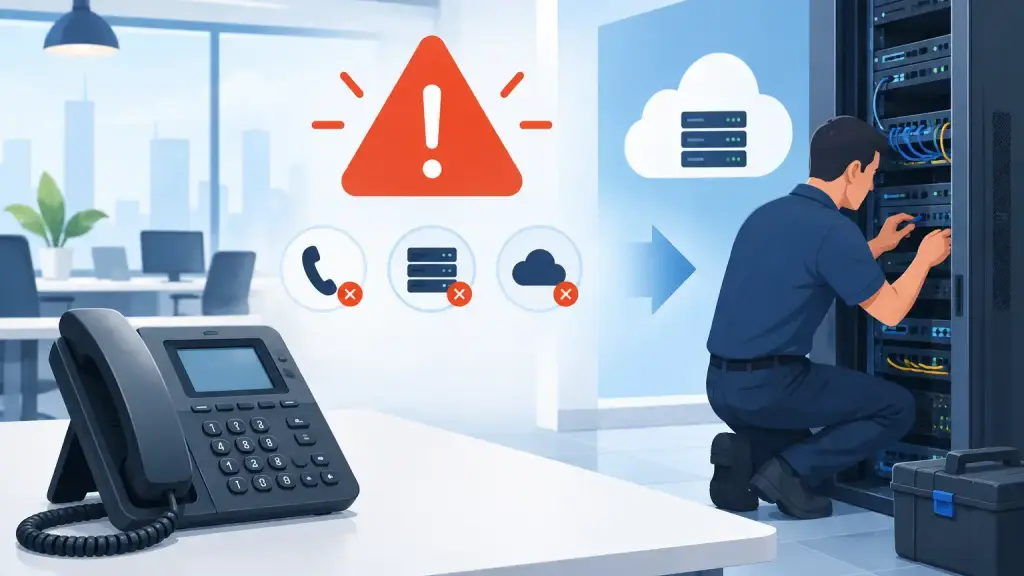
A PBX does not have to fail completely before it becomes a business risk. The top PBX migration warning signs often appear as small operational problems: a phone that needs resetting, a card that is hard to source, an extension that cannot be moved without a service call, or a growing list of employees who need features the current system cannot provide. Left unaddressed, those issues can turn a routine repair into an urgent outage.
For Chicago-area businesses that rely on phones for scheduling, customer service, sales, dispatch, or emergency coordination, the decision is not simply old system versus new system. The right question is whether the current PBX can still support the organization reliably and whether a planned migration will reduce risk without disrupting day-to-day work.
Top PBX Migration Warning Signs to Watch
Repairs are becoming reactive instead of preventive
A legacy PBX can remain dependable for many years when it is maintained properly. A single failed handset, power supply, or station card does not automatically mean the system should be replaced. The concern begins when failures become frequent, recurring, or difficult to diagnose.
If your team is calling for emergency service more often, losing dial tone on groups of extensions, or relying on temporary workarounds to keep calls moving, the system may be approaching a point where repair costs and downtime exposure outweigh the value of keeping it in place. Repeated trouble is also a sign to review the full installation, including cabinet condition, wiring, power protection, voicemail, and outside line connections. The PBX may not be the only source of the problem.
Replacement parts are difficult to find
Older Panasonic, Nortel, Avaya, Vodavi, and NEC systems can often be repaired with tested replacement hardware. However, availability matters. When a critical card, processor, power supply, or compatible phone is no longer readily available, every future failure carries more risk.
Businesses should not wait until a core component fails to learn that replacement options are limited. Ask what parts are still supporting the system, which components are most likely to cause a major outage, and whether spares can be secured. In some cases, maintaining the existing PBX with a practical inventory of critical parts remains the right decision. In others, scarce hardware is a clear reason to plan a controlled move to hosted VoIP.
Your phone system cannot support how people work now
A PBX that worked well for a single office may struggle when the organization adds remote staff, satellite locations, flexible schedules, or new customer-service workflows. Employees may be forwarding calls to personal devices, sharing extensions, or using informal workarounds because the current system cannot provide reliable mobility, visibility, or call routing.
These workarounds can create service gaps. Calls may be missed, transferred inconsistently, or handled without a clear record of who answered them. If staff need features such as mobile access, voicemail-to-email, flexible call queues, easier extension management, or multi-location routing, a hosted platform may better match the way the business operates. The goal is not technology for its own sake. It is making sure calls reach the right person without adding unnecessary steps for employees or customers.
Moves, changes, and additions take too long
Adding an employee should not require weeks of planning or force a business to compromise on phone coverage. If every extension change requires specialized hardware, an on-site visit, or a difficult programming process, the system may be limiting growth.
This issue becomes especially visible during office relocations, expansions, mergers, or departmental changes. A legacy PBX may require new cabling, cabinet capacity, line cards, and programming before a new workstation can be activated. Those needs are manageable when changes are occasional and the infrastructure is in good condition. They become a warning sign when the organization is changing faster than the phone system can adapt.
The business has no documented recovery plan
Many companies do not discover how dependent they are on their PBX until power loss, hardware failure, building work, or carrier trouble interrupts service. If no one can explain how incoming calls would be routed during an outage, who has access to system programming, or how quickly critical hardware can be replaced, there is an operational gap.
A migration assessment should include more than feature comparisons. Review your current call flow, main number routing, emergency calling requirements, after-hours coverage, voicemail, cabling, network readiness, and backup power. A modern hosted platform can improve continuity, but it still depends on proper network design and a plan for an internet outage. A poorly planned VoIP deployment can introduce a different set of problems.
When Repair Is Still the Smarter Move
Not every older PBX needs to be migrated immediately. If the system is stable, parts are available, users are satisfied, and the business does not need advanced mobility or multi-site capabilities, professional maintenance can be the practical choice. Replacing a functioning system simply because it is old can create avoidable cost, training demands, and disruption.
A repair-first approach is also useful when a company needs time to budget, evaluate workflows, or prepare its network. Maintaining the legacy system while building a migration plan gives leadership control over the timeline. It avoids the pressure of making a major communications decision during an emergency.
The key is to distinguish manageable age from unacceptable risk. A qualified technician can inspect the system, identify weak points, verify part availability, and explain which repairs are likely to extend service life. That gives decision-makers facts instead of assumptions.
How to Plan a PBX Migration Without Disrupting Calls
A successful migration begins with discovery. Document every main number, direct number, extension, hunt group, call queue, auto attendant option, fax line, alarm connection, door entry device, paging interface, and conference requirement. These details are easy to overlook and can cause real disruption if they are not addressed before cutover.
Next, evaluate the network. Hosted VoIP depends on stable internet connectivity, suitable switching equipment, adequate bandwidth, proper voice prioritization, and backup power for network equipment. Businesses with older cabling or unmanaged network hardware may need infrastructure work before they are ready to move phones to the cloud. An on-site assessment is often more reliable than assuming the existing network can handle voice traffic.
Training should be part of the plan, not an afterthought. Even a well-configured phone system creates frustration if users do not understand transfers, parking, voicemail, conferencing, call pickup, or mobile features. Supervisors and reception staff may need additional training because they manage the call flows that affect the entire organization.
Finally, schedule the cutover around operations. Some businesses can transition after hours or over a weekend. Others need a phased approach that keeps selected departments or locations on the existing PBX while new service is activated. The best method depends on the number of users, the complexity of call routing, carrier timing, and how much interruption the business can tolerate.
Questions to Ask Before You Commit
Before approving a migration, make sure the provider can clearly answer four practical questions: What happens to calls during the transition? Which legacy devices need to remain in service or be replaced? Is the network ready for voice traffic? Who will be available if a problem occurs after cutover?
The answers reveal whether the project is being treated as a complete communications change or merely a phone purchase. Businesses should also confirm who will provide on-site support when needed, handle programming, train users, and respond if the old system fails before the new service is live.
For organizations in Chicago and the surrounding suburbs, iTeleco can evaluate aging PBX equipment, perform repairs when continued service makes sense, and help plan a hosted VoIP transition when modernization is the better path. With 24/7 emergency support available, the priority is keeping communications operational while the business makes a sound decision.
The most useful next step is not to wait for the next outage. Have the current PBX, cabling, call flow, and network reviewed while the system is still working. A clear assessment gives your business time to repair with confidence, migrate on its own schedule, and protect the calls your customers depend on.