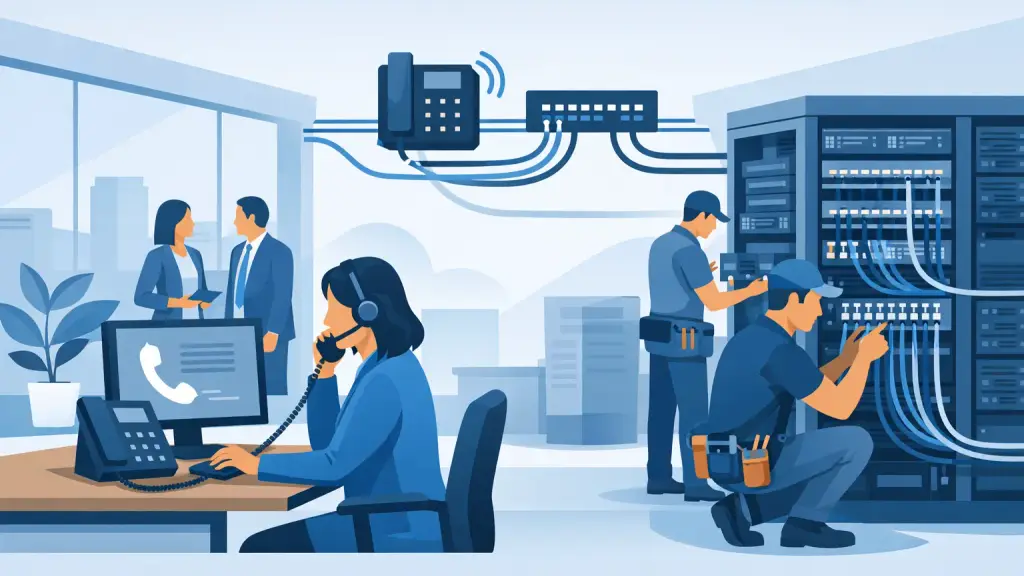
A phone system can be fully operational at the control cabinet and still leave employees without dial tone. The problem is often voice cabling - the wiring, terminations, wall jacks, patch connections, and pathways that carry service from the PBX or phone provider to each extension. When that infrastructure is neglected, a minor fault can look like a major phone-system failure.
For businesses that rely on older PBX equipment, cabling deserves the same attention as handsets, cards, power supplies, and programming. A clear dial tone, dependable call transfer, working voicemail indicators, and consistent service at every desk all depend on a sound physical connection.
What Voice Cabling Includes
Business voice cabling is more than a cable running behind a desk. It is the complete path between a phone-system port and the phone a staff member uses. Depending on the building and system, that path may include station wire, Cat3, Cat5e, or Cat6 cable; 66 blocks, 110 blocks, patch panels, modular jacks, cross-connects, and short patch cords.
In a traditional PBX environment, each extension has a dedicated cable pair or pairs assigned to a specific port. If that pair is loose, damaged, mislabeled, or landed on the wrong terminal, the extension may fail completely or behave inconsistently. A user may hear static, lose caller ID, experience one-way audio, or find that a phone only works when moved to a different jack.
Hosted VoIP phones use the network differently, but the physical layer still matters. A network drop with a bad termination, insufficient PoE capacity, poor labeling, or unreliable patching can take a VoIP phone offline just as effectively as a failed PBX station cable. The technology changes, but the need for disciplined cabling does not.
Why Cabling Problems Are Easy to Misdiagnose
Cabling faults rarely announce themselves clearly. A phone may work in the morning and fail after a desk move. One department may report intermittent service while every other extension is normal. An office manager may replace a handset, only to find the same issue at the next desk.
That is why professional diagnostics should isolate the problem in a logical order: handset, cord, wall jack, station cable, cross-connect, PBX port, and system programming. Skipping steps leads to unnecessary equipment replacement and longer downtime.
Older buildings add another layer of complexity. Over time, cabling can be spliced without documentation, buried above ceilings, routed through former office layouts, or extended with temporary connections that were never intended to remain permanent. Renovations, furniture installations, electrical work, water damage, and pest activity can all affect cable runs that have worked for years.
A reliable technician does not assume every issue requires a new phone system. In many cases, the right repair is a corrected termination, a new station run, a repaired block, or a properly labeled cross-connect. The goal is to restore dependable service with the least disruption to the business.
When Voice Cabling Should Be Tested
Testing is worthwhile whenever phone service becomes unpredictable, but it is especially valuable before a problem becomes an outage. If employees report crackling, dropped calls, no dial tone at a single extension, or phones that work only intermittently, the cable path should be inspected before blaming the PBX.
Testing also makes sense during office moves and expansions. Adding desks without confirming available cable pairs and port assignments can create confusion on move day. A phone may be connected to an unassigned jack, a live extension may be accidentally disconnected, or two locations may be mislabeled. These are preventable problems when the cabling is mapped before staff arrives.
Businesses should also test cabling before relocating a legacy phone system. The PBX can be transported and reinstalled correctly, yet service will still be delayed if the new location has inadequate station wiring, damaged jacks, or no documented connection points. A pre-move cabling review gives the installer a clear plan and reduces last-minute surprises.
Repair, Replace, or Reuse Existing Cable?
There is no single answer for every office. Existing voice cable can often be reused successfully when it tests cleanly, is properly terminated, and meets the needs of the phone system. Reusing workable infrastructure can reduce disruption, particularly in occupied offices where opening walls or accessing ceiling spaces is difficult.
Repair is usually appropriate when the issue is isolated. For example, a damaged jack, a failed patch cord, an incorrect block connection, or a single compromised cable run may be corrected without rebuilding the entire voice network. This is common in established offices with legacy Panasonic, Nortel, Avaya, NEC, Vodavi, and similar PBX systems.
Replacement is the better choice when faults keep returning, cable routing is unsafe or inaccessible, documentation is missing, or the business is planning a larger technology change. Cat5e or Cat6 structured cabling may support both voice and data requirements, provided the installation is designed and tested correctly. That can simplify future moves, adds, and changes, but it should not be treated as a reason to replace every functional legacy cable immediately.
The right decision depends on the condition of the wiring, the building layout, the number of users, and the business's plans for its phone platform. A repair-first approach is often sensible. A planned replacement is smarter when repeated patchwork is creating operational risk.
Cabling Standards That Prevent Future Downtime
Good voice cabling work should leave the office easier to support than it was before. That starts with clear labeling. Every jack, cable, termination point, and PBX port should have an identifier that matches current records. When an employee changes offices or an extension stops working, accurate labels save time and prevent accidental disconnections.
Cable routing matters as well. Voice wiring should be protected from crushing, sharp bends, moisture, and unnecessary exposure. It should be kept organized in telecom closets rather than left as a tangle of loose jumpers. Clean routing is not cosmetic. It makes faults easier to find and reduces the chance that routine work on one line affects another.
Documentation is equally valuable. A current extension map should show which station port serves each location, where cross-connects are made, and which jacks are spare. For multi-location businesses, each site needs its own accurate records. Without them, a simple office move can turn into an extended troubleshooting project.
Voice Cabling During a Phone System Upgrade
A move to hosted VoIP does not always require a complete recabling project. Some offices have network cabling that can support desk phones, while others need additional drops, corrected terminations, or network-switch upgrades before deployment. The answer depends on the existing infrastructure and the type of phones being installed.
This is where a practical transition plan matters. A business may choose to maintain a legacy PBX while repairing its current station wiring, then move selected departments or locations to hosted VoIP over time. Others may need an immediate replacement after an aging system suffers a major failure. In both cases, inspecting the cabling early prevents the new platform from inheriting old physical-layer problems.
For offices in Chicago and surrounding suburbs, on-site assessment is particularly useful in older commercial buildings where telecom rooms and cable pathways may have changed repeatedly over decades. A field technician can trace live extensions, identify damaged runs, confirm usable infrastructure, and recommend work based on what the building actually needs.
Do Not Let a Cable Fault Stop Your Business
Phones are still central to sales calls, appointment scheduling, dispatch, customer support, and internal coordination. When an extension fails, the cost is not limited to one desk. Calls get missed, staff work around the issue, and customers may assume the business is unavailable.
If your phones have intermittent dial tone, unexplained static, failed extensions, or recurring trouble after office changes, have the cabling checked before the issue spreads. iTeleco provides hands-on voice cabling diagnostics, repair, installation, PBX support, and 24/7 emergency service for businesses that need their communication systems working now.
The most useful cabling investment is not always a full replacement. It is a documented, tested, serviceable connection between your phone system and the people who depend on it every day.