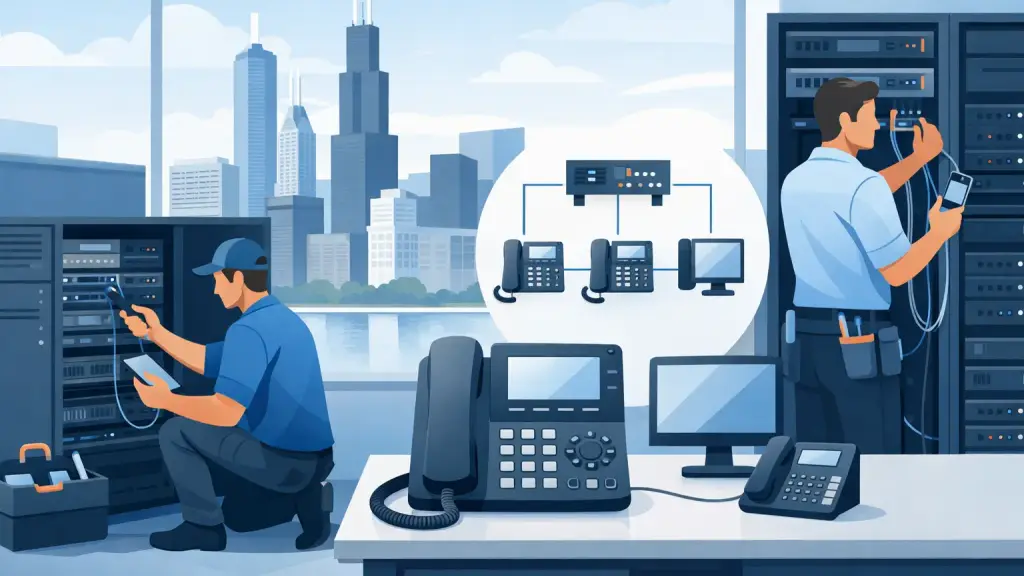
A receptionist picks up the handset and hears silence. Calls are not reaching sales. The front desk cannot transfer a customer to billing. For a business, this is not a minor technical inconvenience. It can stop scheduling, delay service, and leave customers wondering whether anyone is available. Chicago phone repair for business systems needs to start with fast diagnosis, clear communication, and a technician who understands the equipment already in place.
Many Chicago-area organizations still rely on PBX phone systems that have performed reliably for years. Panasonic, Nortel, Avaya, Vodavi, NEC, and similar platforms remain common in offices, warehouses, medical practices, professional firms, and multi-location businesses. The fact that a system is older does not automatically mean it needs to be replaced. It does mean the business needs the right support partner when a failure occurs.
Chicago Phone Repair Is About Restoring Operations
Business phone trouble does not always look like a total outage. One extension may fail while the rest of the office works. Incoming calls may ring but not transfer correctly. Voicemail may stop recording messages, caller ID may disappear, or an after-hours menu may route calls to the wrong destination. These problems can originate in the PBX cabinet, a card, a power supply, programming, station wiring, cabling, carrier service, or the handset itself.
That is why guesswork is expensive. Rebooting equipment may temporarily change the symptom without correcting the cause. Replacing phones before testing the system can create unnecessary expense and more downtime. An experienced technician traces the issue methodically, identifies where communication is breaking down, and repairs the component or configuration that is actually responsible.
For organizations that depend on every call, response time matters as much as technical knowledge. A local provider able to deliver on-site service can inspect the equipment room, test cabling, check extensions, and confirm that the repair works under normal business conditions. Remote support is useful for certain programming issues, but it cannot replace an on-site visit when hardware, wiring, or a system cabinet needs attention.
Common PBX Problems That Need Professional Service
Older business phone systems are durable, but they are not maintenance-free. Power events, aging components, office moves, changes in staffing, and years of adjustments can all create issues that surface at the worst possible time.
A business should request service when it experiences recurring dropped calls, extensions that cannot make or receive calls, failed voicemail, poor audio quality, phones that will not power on, or call routing that no longer matches operations. Problems after a remodel or workstation move also deserve prompt attention. A phone may appear connected while a damaged or incorrectly terminated cable prevents it from working reliably.
Programming changes are another frequent source of trouble. A business may need to add employees, remove former users, change department call coverage, update holiday schedules, revise an auto attendant, or adjust who receives calls after hours. These changes seem small until a missed setting sends customer calls to an unattended extension. Proper PBX programming keeps the phone system aligned with the way the business operates.
Emergency Repair Requires a Different Standard
When all or part of a phone system is down, the immediate priority is continuity. The technician needs to establish the scope of the issue quickly: Is it affecting one user, a department, the entire PBX, or the carrier connection? Is there a power or network issue? Did a recent change trigger the problem?
A practical emergency response also includes workarounds when appropriate. Calls may need to be redirected, key departments may need temporary service restored first, or business-critical lines may require priority troubleshooting. The goal is not merely to close a ticket. It is to get communication back where it is needed most.
iTeleco provides 24/7 emergency repair for businesses that cannot wait until the next business day to address a communications failure. For urgent PBX issues in Chicago and surrounding suburbs, calling 773-340-7777 puts the focus on restoring service quickly and professionally.
Repair, Maintenance, or Replacement: How to Decide
A legacy PBX should be evaluated on its business value, not its age alone. If the system supports current operations, replacement parts are available, and repairs are isolated, continuing to maintain it can be a sensible decision. Many businesses prefer this route because it avoids disrupting users and allows them to plan a future upgrade on their own timeline.
Maintenance is especially valuable for systems that still serve a stable office environment well. Regular attention can identify weak power supplies, failing cards, cabling concerns, poorly labeled extensions, and outdated programming before they become an outage. It also creates documentation that helps future troubleshooting move faster.
Replacement becomes more compelling when the system can no longer support operational needs. That may include frequent failures, limited expansion capacity, difficulty sourcing critical components, multiple locations that need better connectivity, or a workforce that needs more flexibility than a traditional on-premises setup can provide. The decision depends on the condition of the equipment, the cost of ongoing disruption, and the features the organization truly needs.
The wrong approach is treating every old system as obsolete or every repair as a reason to delay modernization indefinitely. A qualified telecom provider should be able to support the existing PBX today while giving the business a realistic path forward when an upgrade makes sense.
When Hosted VoIP Is the Better Next Step
Hosted VoIP can give businesses more flexibility for remote users, multi-location call handling, growth, and administration. It may simplify changes that would otherwise require on-site programming, and it can provide a more adaptable platform for organizations whose communication needs have changed.
However, migration should be planned, not rushed. Before moving to a hosted platform, a business should review internet reliability, network readiness, existing cabling, call flow, number porting requirements, user training, and the equipment needed at each location. A poorly planned transition can create the same downtime it was meant to prevent.
For some organizations, a staged approach is best. Repair and stabilize the legacy PBX first, then schedule a migration around business needs. For others, an immediate upgrade may be justified because the current system has become unreliable or cannot support essential operations. The right answer depends on the business, not on a one-size-fits-all recommendation.
Do Not Overlook Cabling and User Training
The PBX system is only one part of business communications. Structured cabling, wall jacks, patch panels, and workstation connections all affect call quality and reliability. During an office relocation, expansion, or renovation, phone cabling should be designed and tested as carefully as the system itself. Improvised moves and unlabeled connections often lead to avoidable service calls later.
User training also protects the investment. Employees need to know how to transfer calls, set voicemail, use hold and conference features, access directories, and follow the business's call-handling procedures. Administrators should know how to complete basic user changes and when to call for support. Clear training reduces missed calls and prevents simple operating errors from becoming apparent system failures.
What to Expect From a Dependable Service Partner
The strongest telecom service relationship is proactive, not transactional. Your provider should understand the phone system in your building, keep accurate records of programming and extensions, and respond with the urgency that a communications outage demands. For multi-location organizations, consistency matters even more. Each site needs the same level of accountability, whether it is in Chicago, Schaumburg, Naperville, or another nearby community.
Look for a team with experience across legacy PBX brands as well as newer hosted VoIP options. That combination matters because it prevents false choices. You should not have to abandon a working system just because a provider cannot service it, and you should not be locked into old equipment when a modern solution would better serve the business.
If your phones are showing early warning signs, address them before the next busy morning exposes the problem. A fast repair can restore service, but a knowledgeable assessment can help keep the next outage from happening at all.