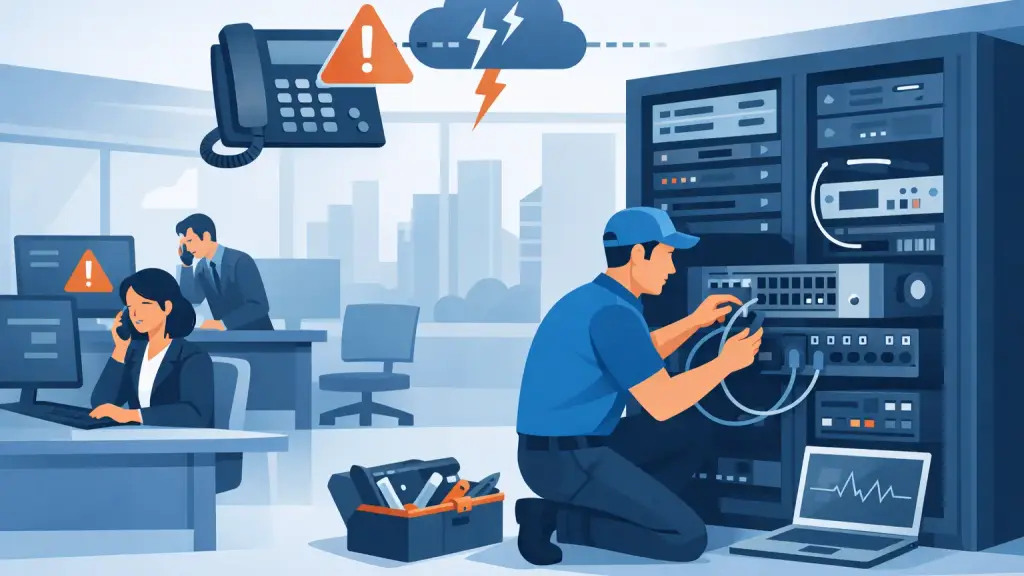
A busy office loses dial tone at 8:10 a.m. Front-desk calls stop ringing, staff cannot place outbound calls, and customers begin hearing a disconnect message. This PBX outage recovery example shows what an effective response looks like when every missed call can affect revenue, scheduling, and customer trust.
The goal is not to make changes quickly for the sake of activity. The goal is to identify where service failed, restore the most important calling functions safely, and confirm that the system is stable before the business resumes normal operations. For companies using an older Panasonic, Nortel, Avaya, NEC, Vodavi, or similar system, that process often requires hands-on knowledge that a general IT provider may not have.
The outage: no inbound or outbound calling
Consider a Chicago-area professional office with a legacy PBX supporting 45 extensions, a receptionist console, voicemail, and several analog lines for fax and emergency use. At opening time, the receptionist reports that every desk phone displays normally but has no dial tone. Outside callers receive a fast busy signal. Internal extension-to-extension calls still work.
Those symptoms narrow the investigation. Because internal calling is available, the PBX itself is powered on and its station side is functioning. The issue is more likely related to the incoming carrier service, the PBX trunk interface, a failed line card, cross-connect wiring, or a programming condition affecting outbound and inbound call routing.
A good recovery starts with a clear record of what changed. Did the building lose power overnight? Was electrical work performed? Did someone move equipment, add a phone, change carrier service, or modify PBX programming? Even a seemingly minor change can point a technician toward the fault and prevent unnecessary disruption.
PBX outage recovery example: isolate before replacing
The technician begins at the demarcation point, where the phone carrier's service enters the building. Testing there determines whether dial tone is reaching the site. If carrier service is absent at the demarc, the immediate action is to document the findings, open the carrier trouble ticket, and establish a temporary call-forwarding plan if one is available.
In this case, dial tone is present at the demarcation point. That moves the fault inside the customer premises. The technician then tests the connection between the demarc and the PBX, checks the surge protection block, and verifies the trunk ports assigned to the incoming lines.
One trunk card shows no status activity, even though the lines feeding it test properly. A visual inspection finds that a power event affected the card and its port indicators are no longer responding. The cabinet power supply remains within specification, so replacing the entire PBX would be premature. The failed component can be isolated to the trunk card.
This distinction matters. An aging PBX does not automatically need to be replaced because of one outage. If the system is otherwise reliable, compatible replacement parts are available, and the repair restores dependable operation, targeted maintenance can be the right business decision. If failures are becoming frequent or key parts are no longer obtainable, a planned migration may make more sense.
Restore critical calls first
Before replacing the card, the technician identifies the business functions that cannot wait. The receptionist and customer service team need inbound calls. Managers need outbound calling to contact customers and vendors. Emergency lines must remain available.
When the configuration allows it, critical incoming lines can be redirected to working ports or forwarded temporarily to an alternate business number. This is not always possible, particularly when every trunk is affected or the carrier configuration is limited, but it should be considered early. Recovery is measured by business impact, not only by whether a technician has located a failed part.
The replacement trunk card is installed, seated properly, and configured to match the original port assignments. The technician then checks programming associated with line appearance, ringing assignments, caller ID, outbound access, and any automated attendant routing. On legacy systems, a card replacement may be physically simple while the programming verification is where service restoration succeeds or fails.
Testing after repair is not optional
A green status light does not prove that the phone system is ready for the workday. The technician should place test calls in both directions and confirm that the expected extensions ring. In this example, the test plan includes calls to the main number, the receptionist group, a direct-dial number, voicemail, and the emergency line.
Outbound testing should cover local and long-distance dialing, if applicable, as well as the codes employees use to access an outside line. Caller ID should be checked in both directions. If the business uses fax, door entry, paging, credit-card terminals, alarm interfaces, or other analog devices connected to the PBX, those functions need separate verification.
The final step is to monitor the system for recurring alarms or intermittent line loss. A repair that works for one call but fails under normal traffic is not a completed recovery. The office manager should also receive a plain-language explanation of the cause, the repair performed, any temporary workarounds removed, and the next recommended maintenance action.
What this example reveals about PBX risk
The failed card was the immediate cause, but the outage exposed a broader issue: the office did not have a current record of its PBX configuration, trunk assignments, or replacement-part plan. Those gaps can add hours to an emergency repair, especially with a system that has been in place for many years.
A practical continuity plan does not need to be complicated. It should identify the PBX model and cabinet location, the carrier account information, main business numbers, key contacts, and the extensions or departments that must be restored first. Keep a current programming backup where the system supports one. Document any special devices tied to phone lines, including elevator, alarm, paging, and door systems.
There is also a trade-off between maintaining a legacy platform and moving to hosted VoIP. A well-maintained PBX can continue serving a business effectively, particularly where existing cabling, phones, and workflows are dependable. Hosted VoIP can add flexibility, remote-user options, and a clearer path away from aging hardware. The right answer depends on call volume, feature needs, condition of the current system, available internet reliability, and the business's tolerance for future hardware risk.
When to call for emergency PBX service
Call for professional support immediately when an outage affects all incoming or outgoing calls, the PBX will not power up, a power event has occurred, or line status suggests a carrier or hardware failure. Avoid repeatedly rebooting the cabinet, moving cards between slots, or changing programming without a verified backup. Those actions can turn an isolated fault into a longer restoration project.
For businesses in Chicago and the surrounding suburbs, iTeleco provides 24/7 emergency repair and on-site support for legacy PBX systems. Fast diagnosis matters, but so does having a technician who can distinguish a carrier problem from a wiring issue, hardware fault, or programming error.
The best time to prepare for a PBX outage is when the phones are working. Confirm who to call, document the system, test your essential call paths, and address aging components before the next busy morning tests them for you.