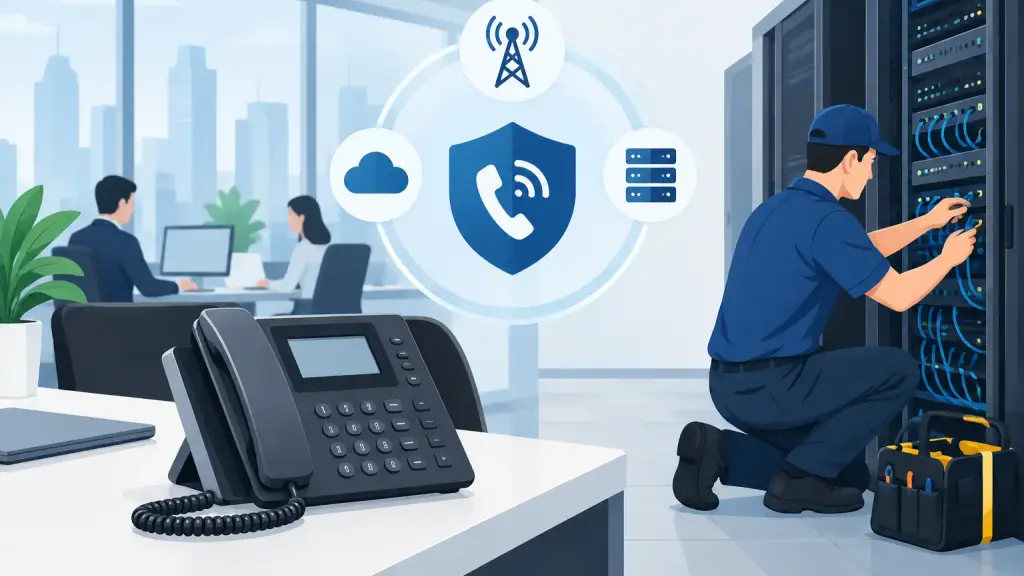
A phone outage rarely begins with a warning. One moment calls are routing normally; the next, the receptionist has no dial tone, a department cannot transfer calls, or an entire location is unreachable. An emergency telecom service review gives your business a practical way to evaluate support before a failure affects customers, staff, scheduling, and revenue.
For businesses running Panasonic, Nortel, Avaya, Vodavi, NEC, or other legacy PBX systems, the right emergency provider is not simply the one that answers the phone. The provider must be able to diagnose the actual issue, obtain or work around aging components, dispatch qualified field technicians when required, and communicate clearly while the outage is being resolved.
What an Emergency Telecom Service Review Should Cover
A useful review starts with your operating reality. A medical office that schedules patients all day, a manufacturer coordinating deliveries, and a multi-location professional services firm may all depend on phone service, but their risks are different. Your review should identify which phone functions are essential, what downtime costs your operation, and who is responsible for making decisions during an incident.
The first question is response. “24/7 support” can mean different things depending on the provider. Confirm whether after-hours calls are handled by trained telecom personnel, how emergencies are triaged, and when an on-site visit is available. A provider should be able to explain the process plainly: who takes the call, what information they need, how remote diagnostics begin, and what happens when the problem requires a technician at your facility.
Next, look at technical fit. Legacy PBX support is specialized work. Many businesses discover this only after calling a general IT resource that does not recognize the system software, cabinet configuration, line cards, voicemail integration, or carrier handoff involved. Ask directly whether the provider regularly services your specific system brand and model. Experience with business telecom in general is useful, but brand-specific diagnostic experience can save significant time during an outage.
The review should also cover the boundaries of support. A phone problem may originate in the PBX, cabling, carrier service, power supply, voicemail platform, programming, or the network equipment supporting a hosted system. A dependable telecom partner does not guess. They isolate the fault, explain what they found, and coordinate the next step if another party must be involved.
Response Time Is More Than a Promise
Fast response is a business requirement, but it should be evaluated beyond a broad marketing claim. The practical issue is whether the provider has a repeatable emergency process and the local capacity to follow through.
Start by asking how the provider classifies an emergency. A complete loss of inbound and outbound calling is clearly urgent. But intermittent calling, failure of a main auto attendant, one-way audio, a damaged cable run, or a department without extensions can also become operational emergencies depending on your business. The right provider listens to the business impact rather than treating every ticket the same.
Remote troubleshooting often gets service moving quickly. A qualified technician may be able to identify a programming issue, reset a failed service, check alarms, confirm whether the carrier circuit is active, or isolate a configuration error without waiting for a site visit. That said, remote support is not a substitute for field service when physical hardware, wiring, power, or equipment-room access is involved. A credible provider will tell you when an on-site technician is the faster path to resolution.
For Chicago-area organizations, local field coverage matters. Weather, traffic, building access rules, and the location of an equipment room can all affect the timeline. Businesses in Chicago, Schaumburg, Naperville, Arlington Heights, and nearby suburbs should confirm that their provider can dispatch locally instead of relying exclusively on remote support or an unfamiliar third party.
Review Legacy PBX Expertise Closely
Older phone systems remain in service because many are stable, familiar, and deeply integrated into daily operations. Replacing a working PBX is not always the immediate answer. However, aging infrastructure requires a partner that understands how to maintain it responsibly.
During your review, ask whether the provider can handle repair, programming, moves and changes, expansion, cabling, voicemail issues, and user training for your system. Emergency repair is strongest when it is supported by a working knowledge of the full installation. A technician who understands how your extensions, hunt groups, call coverage, lines, and voicemail are configured can troubleshoot with far more context.
Parts availability deserves an honest discussion as well. Some legacy components are no longer manufactured, and condition can vary across replacement inventory. A responsible provider will not promise that every discontinued part can be sourced immediately. Instead, they should assess risk, identify vulnerable components, and help you plan around known limitations before a failure becomes critical.
Documentation is another indicator of preparedness. Your business should know the location of the PBX, main power source, network gear that affects calling, carrier demarcation point, and current telecom contacts. Keep current extension lists, emergency call-routing instructions, and authorized decision-makers accessible to the people who will need them. These details may feel administrative until a technician is trying to restore calls at 7:00 a.m.
Confirm On-Site Capability and Accountability
An emergency provider should take ownership of diagnosis, not just report that “the phones are down.” The service experience should produce clear answers: what failed, what was tested, what was repaired, what remains at risk, and what your team should do next.
Ask how work is documented after an emergency call. A useful service report identifies the affected equipment or service, the observed symptoms, the corrective action, and any recommended follow-up. This gives office managers and IT leaders a record they can use to prevent repeat issues, communicate with leadership, and budget for maintenance or future improvements.
Accountability also means avoiding unnecessary disruption. Not every outage calls for a major system replacement, and not every older system should be kept indefinitely. A qualified telecom partner should present the practical options based on condition, business needs, available support, and growth plans. Sometimes a focused repair and preventive maintenance plan is the right decision. In other cases, a staged move to hosted VoIP may reduce risk and make sense for a changing workforce or multi-location operation.
The key is that modernization should be a business decision, not a panic decision made while calls are down. Your emergency support provider should be capable of repairing what you have today while giving you a clear path forward when you are ready.
Questions to Ask Before You Need Help
A short review meeting can reveal whether a telecom company is prepared to support your business under pressure. Ask these questions before signing up for support or placing an emergency call:
- Do you provide live 24/7 emergency support for business phone outages?
- Do your technicians regularly service our PBX brand, model, and voicemail configuration?
- Can you perform both remote diagnostics and on-site repair when needed?
- What information should we provide when reporting an outage?
- Can you support cabling, programming, relocations, and system changes in addition to repairs?
- How do you document the cause of an outage and recommend preventive follow-up?
The answers should be specific. Vague assurances are not enough when your main number is failing or customer calls cannot reach the right department.
Prepare Your Team for the Next Telecom Emergency
The strongest emergency response begins before the emergency. Assign one primary contact and one backup who can authorize service, provide building access, and explain the business impact. Keep key details available, including the main phone number, affected extensions, PBX model, symptoms, time the issue began, recent changes, and whether the problem affects inbound calls, outbound calls, or both.
It also helps to decide how your business will communicate during a prolonged interruption. Staff may need an alternate number, a temporary call-routing plan, or instructions for customers whose calls cannot be answered normally. These decisions are much easier to make during normal operations than in the middle of a busy workday.
For businesses that need experienced support for legacy phone systems and a practical path to hosted VoIP when appropriate, iTeleco provides 24/7 emergency repair and local field service throughout Chicago and surrounding suburbs. A quick review of your current system, emergency contacts, and support process can turn a future phone outage from a business crisis into a managed service event.