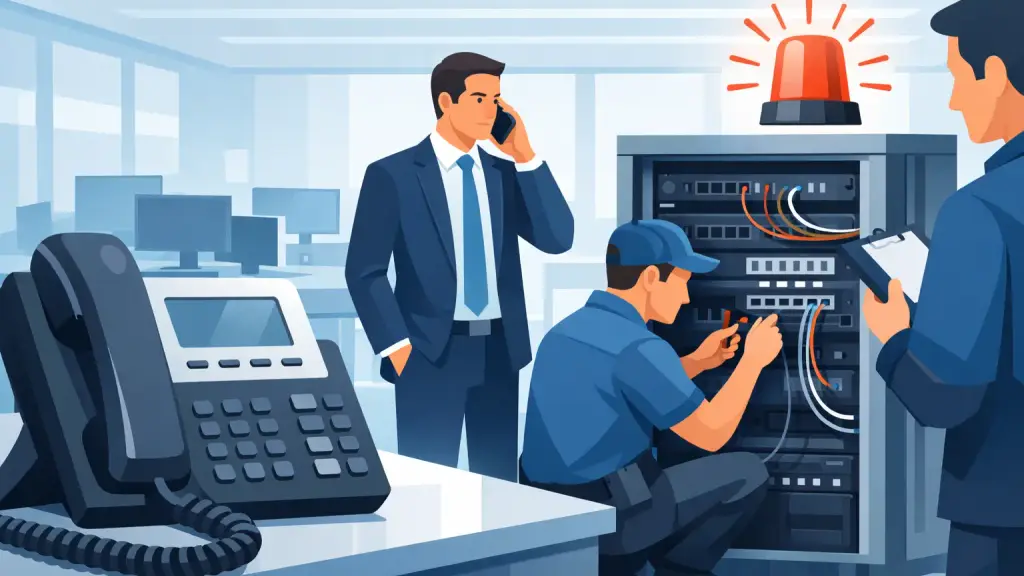
When your phones go down at 9:05 on a Monday, it does not feel like a minor technical issue. It feels like missed customers, stalled scheduling, frustrated staff, and a business that suddenly cannot respond. Emergency business phone repair matters because even a short outage can disrupt sales, service, dispatch, and internal coordination across the entire office.
For many companies, the risk is higher than it looks on paper. A legacy PBX may have been working reliably for years, but age, power events, carrier changes, worn hardware, cabling faults, and programming errors can turn a stable system into an urgent repair call without much warning. The real question is not whether a phone issue can be fixed. It is how quickly the problem can be diagnosed, whether the repair is practical, and what should happen next to reduce the chance of another outage.
What emergency business phone repair usually involves
In the field, emergency business phone repair is rarely one single problem. A company may report that all phones are dead, but the root cause could be a failed power supply, damaged station card, disconnected smart jack, corrupted programming, handset failure, bad inside wiring, or trouble with the carrier handoff. Sometimes the phones still power on, yet there is no dial tone, inbound calls do not ring through, voicemail is unavailable, or one department is down while the rest of the office is still operating.
That is why speed alone is not enough. A fast response only helps if the technician can isolate the fault accurately. Businesses with older Panasonic, Nortel, Avaya, Vodavi, or NEC systems often need a repair partner who understands the equipment well enough to tell the difference between a simple programming issue and a failing hardware component. Guesswork wastes time, and in an outage, time is exactly what you do not have.
The first hour matters most
The first hour of an outage is where good decisions make a real difference. If the issue is handled methodically, service can sometimes be restored faster than the business expects. If the response is scattered, a manageable fault can turn into a longer disruption.
A practical emergency process starts with narrowing the scope. Is the full system down, or only certain phones? Are outbound calls failing, inbound calls failing, or both? Did the outage begin after a storm, office move, internet change, electrical work, or carrier activity? Those details help determine whether the problem is likely tied to the PBX cabinet, the handsets, the cabling, the carrier, or recent programming changes.
Power should be checked immediately, but not casually. It is common for businesses to assume a system has failed when the issue is a tripped circuit, failed battery backup, loose power connection, or surge damage. On the other hand, rebooting equipment too quickly can complicate diagnostics, especially on older systems with unstable cards or partial failures. It depends on the platform and symptoms.
Common failures behind a business phone outage
Some phone emergencies are straightforward. Others are layered. A technician may arrive for what looks like a dial tone issue and find both a cabling fault and a weak station card contributing to the symptoms.
Hardware failure is one of the most common causes in legacy environments. Systems that have run for years can develop problems in expansion cards, power supplies, processors, and voicemail modules. Heat, dust, age, and previous electrical events all add up. In many offices, the phone room is also used for storage or sits in a space with limited climate control, which does not help aging equipment.
Carrier-related issues are another major factor. Businesses sometimes replace internet service, relocate lines, or make network changes without realizing how those changes affect analog trunks, PRI circuits, SIP handoff, or integrated devices like fax lines and alarms. The result can look like a PBX failure when the underlying problem sits outside the cabinet.
Inside wiring problems are easy to overlook. A bad punch-down, damaged cable run, failed patching, or construction-related wiring disruption can take out key phones or departments. These problems often show up after office reconfigurations, renovations, or vendor work that touched nearby infrastructure.
Then there are programming issues. Misrouted calls, broken hunt groups, auto attendant failures, and extension problems can happen after a system change, even if the hardware is fine. These are urgent issues too, especially for businesses that depend on reception, call queues, or departmental routing to handle customer demand.
Repair or replace? It depends on the situation
Not every emergency should trigger a full system replacement. Not every repair should be stretched further, either. The right answer depends on the severity of the failure, the age of the equipment, parts availability, and how critical the system is to daily operations.
If the issue is isolated and the system is otherwise stable, emergency repair is usually the most practical move. Replacing a failed card, correcting programming, repairing cabling, or restoring carrier connectivity can get a business back online quickly without forcing a rushed migration.
But there are cases where the outage exposes a bigger problem. If replacement parts are hard to source, multiple components are failing, or the business has outgrown the system, a repair may only buy short-term relief. In that case, the smartest emergency response may include both immediate restoration and a near-term modernization plan.
That is where businesses benefit from working with a provider that understands both legacy phone systems and hosted VoIP. A company should not be pushed into replacing equipment simply because the technician cannot support older platforms. At the same time, a business should not stay on a fragile system just because it still technically powers on.
Why local response matters for emergency business phone repair
Remote support can solve some issues, especially programming errors or configuration problems. But many business phone emergencies still require hands-on work. Failed hardware, damaged cabling, patch panel faults, power problems, and physical line issues often need an on-site technician who can test, isolate, and repair the system directly.
That is one reason local service matters so much. A Chicago-area business dealing with an outage usually cannot afford to wait on a national queue or explain an older PBX to a rotating call center. They need a specialist who can respond quickly, work on site if needed, and understand the realities of business telecom infrastructure in real offices, warehouses, clinics, and multi-tenant buildings.
For businesses in Chicago and surrounding suburbs, that local knowledge also helps during moves, line changes, carrier coordination, and after-hours emergencies. Older systems are not always documented well. A technician with field experience can often recognize patterns and restore service faster than someone relying only on generic troubleshooting scripts.
How to reduce the next outage
Emergency repair is about restoring service now, but smart businesses use the event to reduce future risk. That usually starts with identifying what failed, why it failed, and whether the surrounding infrastructure needs attention.
If a battery backup did not hold, replace it. If the phone room lacks cooling or proper protection, fix that. If the business depends on one aging cabinet with no contingency plan, it may be time to discuss staged upgrades, spare parts strategy, or migration planning. If call routing is critical, verify that failover options and backup procedures are documented and tested.
Even small improvements can make a difference. Updated programming records, labeled cabling, checked power protection, and periodic PBX maintenance can shorten future outages significantly. The goal is not perfection. The goal is fewer surprises and faster recovery when something does go wrong.
Choosing the right repair partner
Emergency support is not just about who answers the phone. It is about who can actually solve the problem under pressure. Businesses should look for a provider with real experience in legacy PBX repair, on-site service capability, and the ability to support both older systems and modern alternatives when needed.
That is especially true for companies still relying on established platforms from Panasonic, Nortel, Avaya, Vodavi, NEC, and similar manufacturers. These systems can often be maintained successfully, but only by technicians who know how they behave in the real world.
Iteleco.com provides emergency business phone repair, PBX support, and fast-response service for businesses in Chicago and surrounding suburbs. If your phones are down, if your system is unstable, or if an older PBX is becoming harder to support, call (773-340-7777). The fastest fix is usually the one that starts with an experienced diagnosis, not a guess.
When business communications fail, the priority is simple: restore service, protect continuity, and make the next emergency less likely.