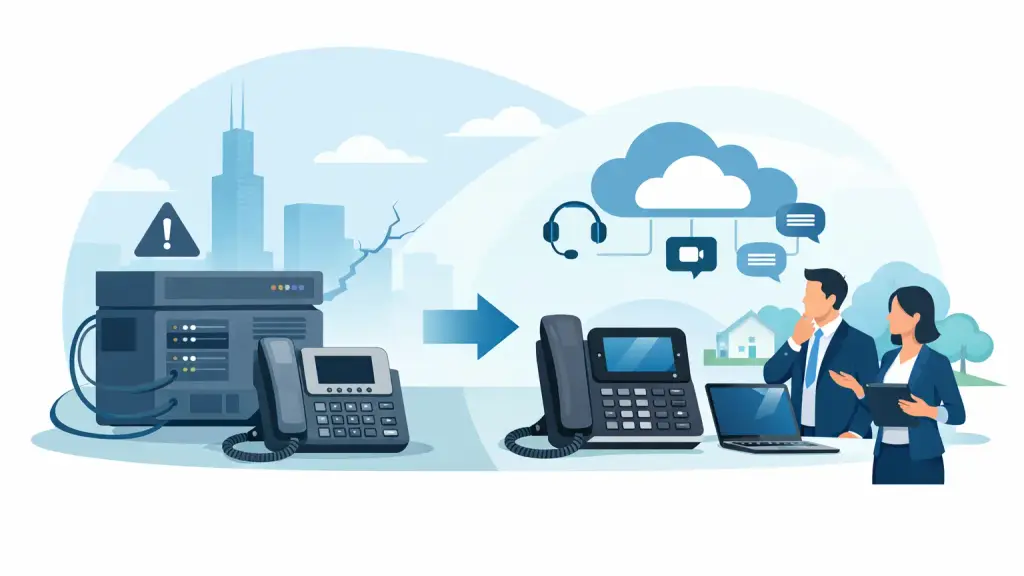
A PBX does not usually fail all at once. More often, it starts with small problems that become expensive habits - dropped calls, aging cards, voicemail issues, lines that stop working, and service delays because replacement parts are harder to find. If you are asking when to replace PBX equipment, the real question is whether your current system still supports daily business without putting operations at risk.
For many businesses, replacing a PBX too early wastes money. Replacing it too late creates a different kind of cost: downtime, lost calls, frustrated staff, and emergency decisions made under pressure. The right timing depends on reliability, supportability, growth plans, and whether the system still matches how your company communicates today.
When to Replace PBX Systems
The clearest sign is not age alone. A 15-year-old system that is stable, properly maintained, and still supported may be a better fit than a newer one that has recurring issues. What matters is whether the system can be repaired, programmed, and scaled without constant disruption.
If your team is calling for service more often, or if every move, add, or change has turned into a workaround, the PBX may be reaching the point where ongoing maintenance no longer makes financial sense. That does not mean every legacy system should be removed. It means the system should be evaluated based on business impact, not just on its date of manufacture.
A useful rule is this: if the cost and frequency of repair are rising while system capability is falling behind your operational needs, replacement should be on the table.
The warning signs businesses should not ignore
One of the biggest warning signs is parts availability. Many legacy PBX platforms still perform well, but once cabinets, processor cards, voicemail components, or proprietary phones become difficult to source, repair timelines get longer and less predictable. That is manageable when issues are rare. It becomes a serious problem when even a minor failure can affect your ability to answer calls.
Another sign is repeated service interruptions. If the system resets unexpectedly, loses programming, drops trunks, or has station ports that fail intermittently, you may be dealing with deterioration that will continue to surface in new ways. A business phone system does not need to be completely down to be a problem. If it creates daily friction for reception, sales, dispatch, or administration, it is already hurting productivity.
Capacity is another issue. Many older PBX systems were built for a fixed office footprint and a predictable call flow. If your business has added remote users, multiple locations, changing departments, or a higher call volume, the old platform may still technically work but no longer fit the way your company operates. That mismatch often shows up as patchwork programming, external workarounds, and limits on expansion.
There is also the support issue. Some manufacturers have ended support on older models, and many telecom providers no longer want to work on legacy equipment. If you have trouble finding qualified technicians for your specific platform, the system becomes a business continuity risk. The right service partner can extend useful life, but there is a point where unsupported hardware turns every repair into a gamble.
Repair or replace? It depends on the failure pattern
Not every problem justifies a full replacement. A failed power supply, bad card, damaged station port, or programming issue can often be corrected quickly and cost-effectively. If the system has been stable for years and this is an isolated event, repair usually makes sense.
Replacement becomes the smarter option when failures are no longer isolated. If one repair leads to another, if different subsystems are showing age at the same time, or if your business has already spent heavily on keeping the platform alive over the last 12 to 24 months, the math changes. At that point, you are not investing in reliability. You are paying to postpone a decision.
This is especially true for offices that cannot tolerate downtime. Medical practices, law firms, manufacturers, property managers, and service businesses often depend on every inbound call being answered and routed correctly. In those environments, even a short outage can disrupt revenue, scheduling, customer service, and internal coordination.
When replacement makes sense even if the PBX still works
A system does not need to be broken to be replaced. Sometimes the strongest reason is that the business has outgrown it.
If your company needs better call reporting, easier remote access, mobile integration, multi-site connectivity, or simpler user management, an older PBX may force your staff to work around limitations every day. Those limitations cost time. They also make training harder and routine changes more dependent on outside support.
There is also a staffing reality. If only one person knows how to manage the system, and that person leaves, retires, or becomes unavailable, the organization becomes vulnerable. Modernizing can reduce dependence on hard-to-find expertise and make everyday administration easier for your team.
Budget planning is another reason to act before failure. Replacing a PBX in a controlled, scheduled project is very different from replacing one after a critical outage. Planned projects allow time for system design, user training, cabling review, number coordination, and cutover planning. Emergency replacements usually happen with fewer options and more business risk.
How to decide when to replace PBX hardware
A practical evaluation starts with three questions. First, is the system reliable enough for current operations? Second, can it be supported with reasonable repair timelines and parts availability? Third, does it still fit where the business is headed over the next three to five years?
If the answer to all three is yes, keeping the PBX may be the right move. Many businesses still get solid value from legacy systems when they are properly maintained by technicians who know the platform. If the answer is no to one question, you may need closer monitoring and a contingency plan. If the answer is no to two or three, replacement should move from a future discussion to an active project.
It also helps to look at recent spending honestly. If you have paid for repeated service calls, temporary fixes, used replacement parts, or recurring programming corrections, compare that total with the cost of moving to a supported platform. Businesses often underestimate how much they are already spending to maintain an aging system that no longer serves them well.
The transition does not have to be all or nothing
One reason companies delay replacement is fear of disruption. That concern is valid. Phone systems are mission-critical, and no one wants a messy cutover.
But replacing a PBX does not always mean ripping everything out overnight. In many cases, there are staged options. A business may keep parts of its current infrastructure while transitioning users, locations, or call paths in phases. The right approach depends on cabling, internet readiness, handset needs, user count, and whether the goal is to preserve some existing investment or move fully to a new environment.
That is why a site-specific assessment matters more than generic advice. An office with a stable legacy key system and modest needs may be better served by continued maintenance for now. A multi-location company with aging hardware and growing mobility requirements may need a faster path to replacement.
For businesses in Chicago and surrounding suburbs, local response matters just as much as technical capability. When phones are down or a migration is underway, you need a provider who can assess the existing system, explain the trade-offs clearly, and support both legacy repair and modernization. Iteleco.com provides that kind of practical support for businesses throughout Chicago and surrounding suburbs, with 24/7 emergency service available at (773) 340-7777.
The best time to replace a PBX is before the system forces the decision for you. If your current setup is becoming harder to support, more expensive to maintain, or less aligned with how your business works, waiting rarely improves the outcome. A careful evaluation now gives you options, leverage, and a much better chance of making the change on your terms.