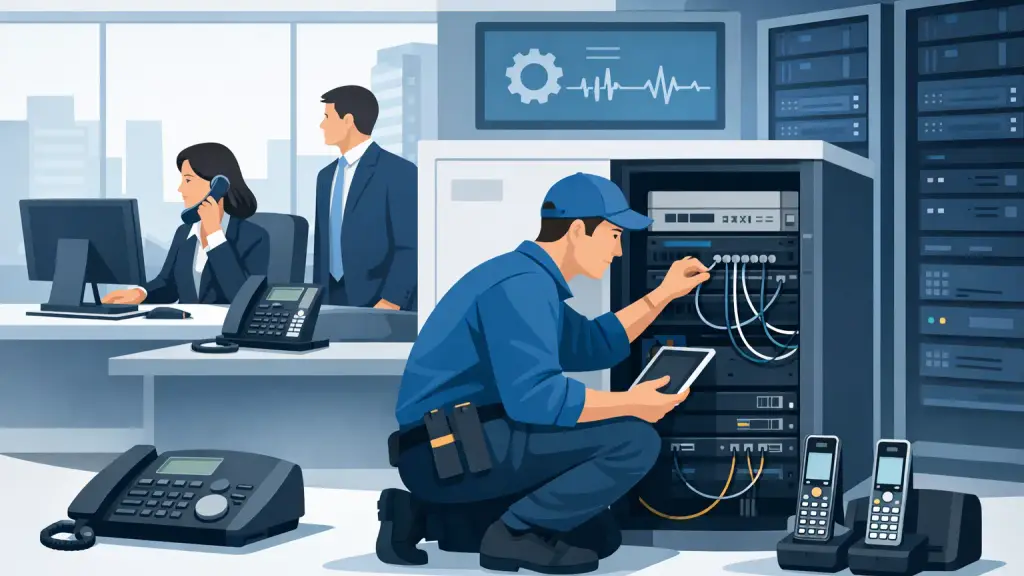
A failed Panasonic business phone system rarely announces itself at a convenient time. One department may lose dial tone, incoming calls may stop routing correctly, or voicemail may become inaccessible just as the office opens. This Panasonic repair service review explains what businesses should expect from a qualified service partner, how to judge the repair decision, and when an aging PBX should become part of a practical upgrade plan.
For organizations that still depend on Panasonic hardware, the right answer is not automatically replacement. Many systems can continue supporting daily operations when they are diagnosed correctly, repaired with compatible parts, and maintained by technicians who understand the platform. The concern is not simply the age of the equipment. It is whether the system can be restored quickly, supported responsibly, and aligned with the way your business communicates now.
What a Panasonic Repair Service Should Actually Deliver
A credible repair service begins with diagnosis, not guesswork. A phone that will not power on may point to a handset, station port, cable run, power supply, card, programming issue, or a network-related problem affecting connected equipment. Replacing parts before isolating the cause can extend downtime and create unnecessary disruption.
For a business PBX, the technician should evaluate the full call path. That includes the main cabinet and processor, power and backup power, trunk connections, station cards, extensions, voicemail integration, auto attendant behavior, and the physical cabling that connects users to the system. A reported issue with one phone can be local. A reported issue with every phone is usually more urgent and requires a broader assessment.
The service should also account for business impact. A repair that restores one extension is useful, but it is not enough if reception still cannot transfer calls, a sales team cannot receive outside calls, or emergency routing is unreliable. Strong support focuses on restoring the functions your operation needs first, then addressing secondary items and documenting any remaining risks.
Fast response matters more than a generic promise
Phone downtime can mean missed appointments, delayed dispatches, frustrated customers, and staff relying on personal workarounds. For that reason, a repair provider should have a defined process for urgent calls: collect the symptoms, determine whether remote troubleshooting can safely narrow the issue, dispatch on-site support when needed, and communicate clearly about the next step.
Remote assistance is valuable for simple programming corrections or checks that can be completed without disturbing the system. It does not replace an on-site visit when there is a suspected power failure, damaged hardware, failed cabling, widespread station outage, or intermittent issue that requires testing at the equipment location.
Twenty-four-hour emergency availability is particularly relevant for offices with extended hours, healthcare-adjacent operations, warehouses, property management teams, service companies, and any business where a call outage cannot wait until the next business day. The useful measure is not the phrase "emergency support" alone. It is whether the provider can triage the situation, respond with the necessary technical experience, and take ownership until communications are stable.
Panasonic Repair Service Review: The Technical Standard
A Panasonic repair service review should assess expertise as closely as availability. Legacy business phone systems have model-specific hardware, programming structures, feature codes, and compatibility limitations. An experienced technician can tell the difference between a system defect, a carrier-side issue, a handset problem, and a configuration change that accidentally affected call handling.
That distinction saves time. For example, a busy signal on incoming calls could be caused by a problem with the incoming service, a trunk card, call routing programming, capacity limits, or a temporary condition that requires testing rather than a permanent repair. Treating every symptom as a hardware failure is not a service strategy.
Good technical support also includes careful programming. Businesses often need more than a part replacement after an outage. They may need extensions reassigned, hunt groups corrected, voicemail boxes restored, after-hours schedules updated, or caller routing adjusted for a changed department structure. These details are where a repair becomes operationally complete.
Documentation is another practical sign of quality. Your provider should be able to identify the affected equipment, note the work performed, explain any temporary measures, and flag components that may create future risk. This helps an office manager or IT leader make better decisions instead of rediscovering the same system history during the next incident.
Repair or Replacement Depends on More Than System Age
An older Panasonic PBX is not automatically a bad investment. If it is stable, supports the required number of users, has serviceable components, and meets current calling needs, repair and preventive maintenance can be the least disruptive choice. This is common for organizations that need dependable communications without forcing a rushed technology project.
Replacement becomes more reasonable when outages recur, parts are difficult to source, the system cannot support changed workflows, or the business needs capabilities the platform was not designed to provide. Multi-location call handling, remote users, flexible scaling, and modern administrative controls may point toward a hosted VoIP solution rather than another major investment in legacy hardware.
The decision should not be framed as old versus new. It should be based on operational risk. A well-maintained legacy system can remain valuable, while a newer platform can be the better fit if it reduces complexity and supports the way employees and customers communicate today.
A qualified provider should be able to support both paths without forcing a premature answer. Repair may be the immediate priority, especially during an outage. After service is restored, the business can evaluate the system's condition, likely support horizon, and any modernization goals with clear information rather than pressure.
A staged transition can protect continuity
Some businesses do not need to replace every phone and process at once. A staged plan can address the most urgent limitations while preserving reliable equipment during the transition. The right approach depends on the current system, site layout, cabling, call volume, and the number of locations involved.
That is where a service partner with legacy PBX knowledge and hosted VoIP capability provides a distinct advantage. The team understands what must remain operational during the change, rather than treating the old system as an obstacle. iTeleco supports businesses throughout Chicago and the surrounding suburbs with this practical repair-first, upgrade-when-ready approach.
Questions to Ask Before Scheduling Panasonic PBX Service
The right questions quickly reveal whether a provider is prepared for a business-critical repair. Ask whether the technician services your Panasonic system type and can work with both hardware and programming. Confirm whether emergency response is available when the outage affects incoming or outgoing calls. If on-site work may be needed, ask how the provider handles cabling, power-related issues, replacement components, and post-repair testing.
It is also reasonable to ask what happens after the immediate issue is resolved. A useful service visit should leave you with a clearer view of the system's condition. You should know whether the failure appears isolated, whether there are additional warning signs, and whether a maintenance or transition plan deserves discussion.
Avoid providers who promise an answer before gathering basic facts about the symptoms, system configuration, and business impact. Speed matters, but accurate diagnosis is what prevents a short-term patch from becoming the next outage.
The Business Value of Ongoing PBX Support
A Panasonic system often receives attention only when it fails. That approach can work until a small issue becomes a full interruption. Ongoing support provides a technical point of contact who can handle adds, moves, changes, programming updates, testing, and repairs before problems affect the entire office.
For established businesses, continuity has real value. Employees know the phones, established call flows remain familiar, and customers continue reaching the right people. Maintenance is not about preserving old equipment for its own sake. It is about maintaining a communication system that still performs its job while giving the business time to choose its next move carefully.
If your Panasonic PBX is showing signs of trouble, treat the first incident as a chance to get more than a quick fix. Restore service, verify the functions that matter to your team, and ask for a candid assessment of what will keep your phones dependable over the months ahead.