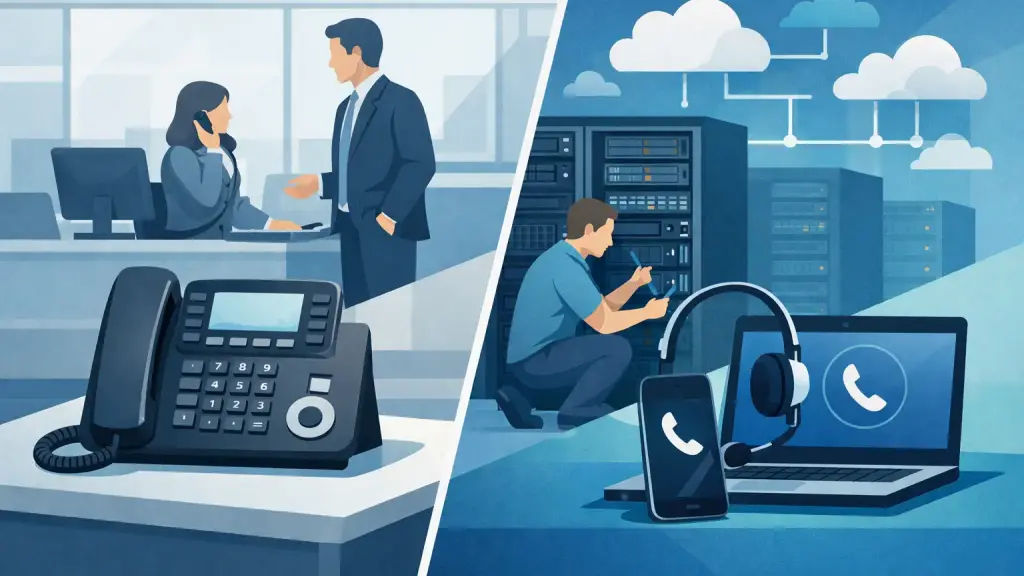
A phone system decision usually becomes urgent when something stops working: a key extension fails, a move exposes old wiring problems, or a growing team runs out of lines. The question of digital phones vs VoIP is not about choosing the newest technology for its own sake. It is about protecting daily operations while selecting a system your staff can use and your business can support.
For many established Chicago-area businesses, digital desk phones connected to an on-premise PBX have delivered dependable service for years. Others need remote access, easier expansion, or a practical exit from aging hardware. Both approaches can serve a business well. The right choice depends on the condition of the current system, the reliability of the network, and how your employees actually work.
What Digital Business Phones Usually Mean
In business telecom, a digital phone is typically a proprietary desk phone connected to a digital PBX or key system. The phone and the system are designed to work together, often using manufacturer-specific cabling, cards, software, and programming. Many offices still rely on these systems because they are familiar, stable, and built around the way the organization handles calls.
A digital PBX keeps call control on-site. Extensions, voicemail, call routing, paging, and other features are managed through equipment at the office. Depending on the installation, the system may use traditional telephone service or newer gateway equipment to connect calls outside the building.
This distinction matters because a digital desk phone is not automatically a VoIP phone. Some newer phones look similar on a desk but use an IP network rather than digital station ports. Before planning an upgrade or repair, identify the actual PBX, phone model, carrier connection, and cabling in place.
Where digital systems still make sense
A well-maintained digital PBX can be a sensible choice when it supports the features your business needs and replacement parts remain available. Reception-heavy offices, medical practices, warehouses, schools, and other sites with established wiring may benefit from keeping a working system in service rather than forcing an unnecessary migration.
Digital systems can also provide predictable internal calling and continue supporting many desk functions during an internet outage. That does not mean every digital system will operate normally during a power failure or carrier disruption. It means the system does not depend on the office data network for every internal call in the same way a hosted platform does.
The downside is that older systems have limits. Expansion cards may be difficult to source, manufacturer support may be reduced, and changes often require an experienced technician. A business with a legacy PBX needs a maintenance plan, accurate system documentation, and a reliable source for emergency repair.
Digital Phones vs VoIP: The Core Difference
VoIP, or Voice over Internet Protocol, carries calls over an IP network. In a hosted VoIP setup, the provider's platform handles much of the call processing off-site, while phones, computers, mobile applications, and network equipment connect to that service through the internet.
The most visible advantage is flexibility. A hosted VoIP user can often take calls from a desk phone, a computer application, or an approved business mobile application. Adding a user, changing call routing, or supporting a second location may be simpler than expanding a physical PBX. That flexibility is valuable for businesses with hybrid teams, multiple offices, changing schedules, or seasonal staffing.
However, hosted VoIP shifts the conversation from PBX hardware to network readiness. Call quality depends on a properly designed internet connection, sufficient bandwidth, reliable switching, correct quality-of-service settings, and backup planning. If the network is poorly configured, more features will not solve dropped calls, one-way audio, or voice delays.
Digital systems rely more heavily on dedicated PBX hardware and local wiring. VoIP relies more heavily on the health of the data network and internet connection. Neither model is automatically more reliable in every building. Reliability comes from proper design, maintenance, and a clear response plan when something fails.
Compare the Operational Trade-Offs
The best decision starts with the business impact of a phone outage. Ask how calls reach your main number, whether employees need to work away from the office, and how quickly the organization must add or move extensions. Then compare the practical trade-offs.
Reliability and continuity
An on-premise digital PBX can be highly dependable when it is professionally maintained. It may keep internal functions available even when the internet is unavailable, depending on the configuration. But aging power supplies, processor cards, cabinet components, and discontinued equipment can create risk if no service partner is available when a failure occurs.
Hosted VoIP removes much of the on-site PBX hardware burden, but it requires internet resilience. A secondary connection, cellular failover, battery backup for network equipment, and thoughtful call-forwarding rules can make a significant difference during an outage. Businesses that choose VoIP should test their failover process before an emergency, not during one.
Growth and office changes
VoIP usually has the edge when an organization frequently adds users, opens locations, or needs staff to answer calls from different places. Centralized administration can make extensions, auto attendants, ring groups, and call routing easier to adjust.
Digital systems can still accommodate changes, especially in a stable office with available ports and compatible phones. The work may be more hands-on, though. Adding a new employee could require a physical phone, a station port, programming, and possibly new cabling.
Features and user experience
Both systems can support essential business functions such as voicemail, call transfer, hold, paging, caller ID, and automated attendants. The difference is often in access and administration. VoIP platforms generally make it easier to extend business calling to remote users and integrate with other workplace tools.
That does not mean a larger feature set is always better. If a front desk team depends on physical line appearances, busy-lamp fields, paging, and familiar call handling, a well-programmed digital console may remain the most efficient tool. Changing systems without training can slow down the people who answer the most important calls.
Infrastructure and support requirements
A digital PBX requires support from technicians who understand that specific system family, its software, cards, phones, and wiring. Not every general IT provider has that experience. When a legacy system is the backbone of an office, brand-specific diagnostic capability matters.
VoIP requires coordinated support across phones, switches, routers, firewalls, internet connections, and the hosted platform. The provider should be able to identify whether a problem is caused by the phone, local network, carrier connection, or call-routing configuration. Avoiding finger-pointing is one reason businesses benefit from a single accountable communications partner.
When Repair Is Smarter Than Replacement
Replacing a phone system solely because it is old can create avoidable disruption. If the existing system is stable, supports the required number of users, has serviceable hardware, and meets operational needs, repair and preventive maintenance may be the responsible choice.
A professional assessment should review the age and condition of the PBX, availability of replacement components, current carrier service, wiring condition, voicemail status, and future capacity. It should also document the failure points that could affect the business, such as a single aging power supply or a cabinet with no available expansion ports.
Repair becomes less attractive when outages are recurring, key components are no longer obtainable, the business needs capabilities the system cannot provide, or the cost and risk of keeping it running outweigh the value of continuity. The answer is not always an immediate full replacement. A phased plan can preserve working equipment while preparing the network, users, and call flow for a future migration.
When Hosted VoIP Is the Better Move
Hosted VoIP is often a strong fit for businesses that need greater mobility, simpler multi-location management, or easier growth without adding more PBX hardware. It can also make sense when an older system has reached its practical end of life and replacement equipment would only postpone a larger decision.
Before moving, confirm that the internet service and internal network can support voice traffic. Review every call path, including the main number, after-hours routing, fax or specialized devices, paging, alarm lines, and reception workflows. These details determine whether a migration feels organized or becomes a disruptive surprise.
User training deserves equal attention. Employees need to know how to transfer calls, access voicemail, use business applications, and handle calls during an internet interruption. A good implementation plans for the people using the system, not just the equipment being installed.
Make the Decision From a Clear Assessment
There is no universal winner in digital phones vs VoIP. A dependable digital PBX may continue serving a stable office very well. A hosted VoIP system may be the better operational fit for a growing or distributed organization. The wrong move is making a decision based only on equipment age or a feature checklist.
For businesses in Chicago and the surrounding suburbs, iTeleco can assess legacy phone infrastructure, provide fast-response repair when a system is down, and help plan a practical transition when modernization is justified. The useful next step is a clear inventory of what you have, what can fail, and what your staff needs from every call. That gives your business a phone strategy built for continuity, not guesswork.