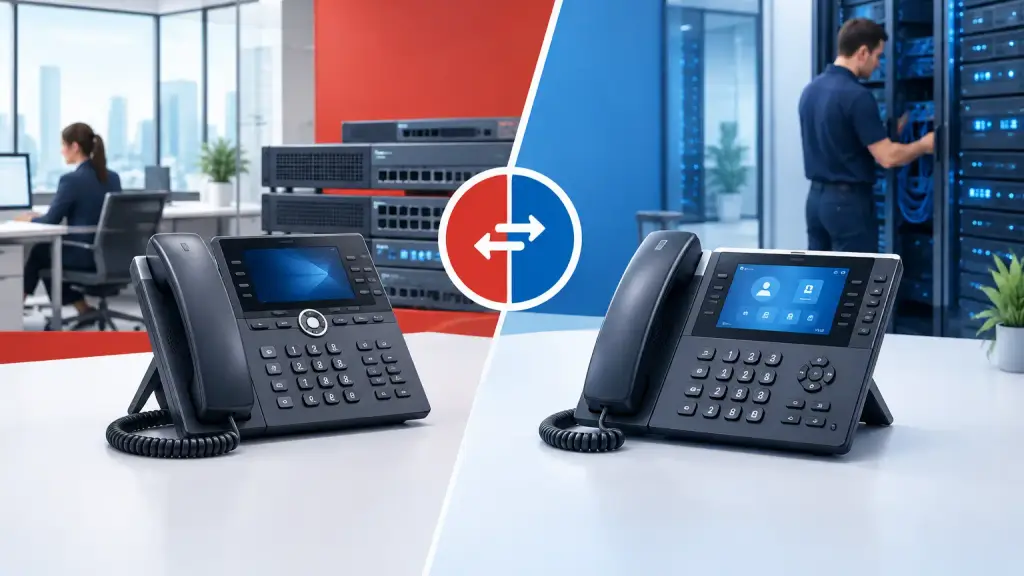
A phone system decision is rarely about the handset sitting on a desk. It affects how quickly calls reach staff, whether customers can get help during an outage, and how much disruption a business can tolerate when equipment fails. In an Avaya vs NEC comparison, the right answer often comes down to the system already in place, the condition of its hardware, and whether the business needs to preserve a working legacy PBX or plan a practical move to hosted VoIP.
For established Chicago-area businesses, replacing a phone system simply because it is older is not always the best operational decision. A properly maintained legacy system can continue to support daily calling reliably. At the same time, aging parts, limited capacity, office moves, and changing work requirements can make an upgrade the smarter long-term choice. The goal is not to choose a brand on reputation alone. It is to choose the support and migration path that keeps your business reachable.
Avaya vs NEC: The Practical Difference
Avaya and NEC have both been widely used in offices, medical practices, professional services firms, warehouses, schools, and multi-location businesses. Each has a long history in on-premises business communications, with systems built around a central PBX or key system, station cards, trunks, voicemail, and proprietary desk phones.
From the user’s perspective, both platforms can provide the essentials: direct extensions, transfer, hold, paging, voicemail, caller ID, call forwarding, conference calling, and automated attendants. The larger difference is usually not the basic feature set. It is the specific platform model, its installed configuration, available parts, software level, and the experience of the technician servicing it.
An Avaya system may be the better choice when it is already deployed, programmed around your call flow, and supported by equipment that remains serviceable. NEC may be the better choice under the same circumstances. Neither answer should be based on a generic feature checklist when a business has years of programming, wiring, phones, and employee workflows invested in its current system.
When Keeping a Legacy PBX Makes Sense
A legacy system deserves consideration when it is stable, fits the business’s current call volume, and can still be repaired with available parts. Many organizations do not need to replace a PBX just because the manufacturer has shifted focus toward newer platforms.
Keeping an existing Avaya or NEC system may be sensible if your staff is comfortable with the phones, your extensions and call routing are working as intended, and your office does not need major changes in mobility or remote calling. It can also be the least disruptive option when an immediate replacement would require retraining users, changing infrastructure, and rebuilding call flows during a busy period.
The key word is maintainable. An older phone system should not be left alone until it fails. Preventive maintenance, documented programming, working backups, replacement handset availability, and a qualified repair resource all reduce the risk that a minor issue becomes a business-wide outage.
What to Check Before Deciding
Before extending the life of any legacy PBX, assess the equipment rather than relying on its age alone. A technician should confirm the condition of the control unit, power supply, cabinets, station cards, trunk connections, voicemail equipment, and cabling. Programming should also be reviewed, especially if past moves, employee turnover, or vendor changes have left the system poorly documented.
Pay close attention to recurring symptoms. Static on lines may point to cabling, handset, line card, or carrier-side issues. Phones that restart, lose display information, or fail to ring can indicate power, card, or programming concerns. Intermittent problems deserve prompt diagnosis because they often get worse at the least convenient time.
Where Avaya and NEC Support Can Differ
With legacy equipment, the quality of support matters more than a product brochure. Avaya and NEC platforms vary by generation, so the technician must understand the exact hardware and software in your building. A service provider should be able to identify the model, trace extensions, test trunks, diagnose failed cards, program features, and source appropriate replacement equipment when possible.
Avaya systems are common in many larger office and enterprise-style environments, but their installed base includes a wide range of systems and configurations. NEC systems also have a substantial footprint among small and midsize businesses, with deployments that may be straightforward or highly customized. In both cases, a business may have proprietary phones that cannot simply be swapped for a different model without considering compatibility and programming.
That is why a brand comparison should include the service history. Ask whether the system has a current programming record, whether spare phones are on hand, and whether the business knows who to call after hours. A system that is technically capable but unsupported is a risk. A well-maintained system with responsive local service can remain a dependable business tool.
Signs It May Be Time to Move Beyond the Existing System
There is a point where repeated repair is no longer the most responsible recommendation. That point is not defined by one failed phone or a single power event. It is reached when reliability, repairability, or business requirements have changed enough that maintaining the old system creates more risk than value.
Consider a migration plan when you are dealing with four or more of these conditions:
- Hardware failures are becoming frequent or affecting multiple users.
- Critical replacement parts are difficult to source or no longer practical to maintain.
- Your business needs easier support for remote staff, multiple offices, or rapid user changes.
- The current system lacks the call reporting, flexibility, or integration your operations require.
- An office relocation, expansion, or major cabling project creates a natural time to reassess the phone environment.
A hosted VoIP platform can reduce dependence on aging on-site control hardware and make it easier to add users, adjust call routing, and support changing work locations. However, the transition must be planned carefully. Internet connectivity, network readiness, call quality, emergency calling requirements, existing phone numbers, training, and business continuity all need attention before cutover.
Do Not Treat a Migration as a Simple Phone Swap
Businesses often underestimate the programming behind their current Avaya or NEC system. Reception coverage, hunt groups, after-hours routing, voicemail greetings, paging zones, door access interfaces, fax lines, alarm circuits, and analog devices may all be part of the setup. Replacing handsets without mapping these functions can create avoidable problems on the first day of service.
A responsible migration starts with an inventory. Document every extension, user, number, line, feature, and connected device. Identify which call paths are mission-critical, such as sales queues, appointment scheduling, dispatch, customer service, and emergency contacts. Then build the new call flow around actual operations rather than around default settings.
Training matters as well. A new platform is only useful when staff knows how to transfer calls, retrieve voicemail, set forwarding, handle shared lines, and respond to basic issues. Short, role-specific instruction can prevent the confusion that often follows a poorly managed system change.
The Best Choice Is Often a Support Strategy
For many businesses, Avaya vs NEC is not really a brand contest. It is a continuity decision. If your current system is stable and repairable, maintain it with documented programming and a response plan for failures. If it is becoming a source of downtime or cannot support how your organization operates, build a staged upgrade plan before an emergency forces a rushed decision.
This is especially relevant for offices that cannot afford missed calls. A medical office may lose appointments. A property management company may miss maintenance requests. A distributor may lose a time-sensitive order. Phone downtime is an operational issue, not just an IT inconvenience.
iTeleco helps businesses throughout Chicago and surrounding suburbs diagnose, repair, maintain, relocate, and program legacy business phone systems while providing a clear path to hosted VoIP when it makes business sense. The right recommendation should be based on the equipment in your building, your call requirements, and the consequences of an interruption.
If your Avaya or NEC phones are showing warning signs, do not wait for the system to fail during business hours. A professional assessment can clarify what is repairable now, what should be documented, and what should be planned for next.