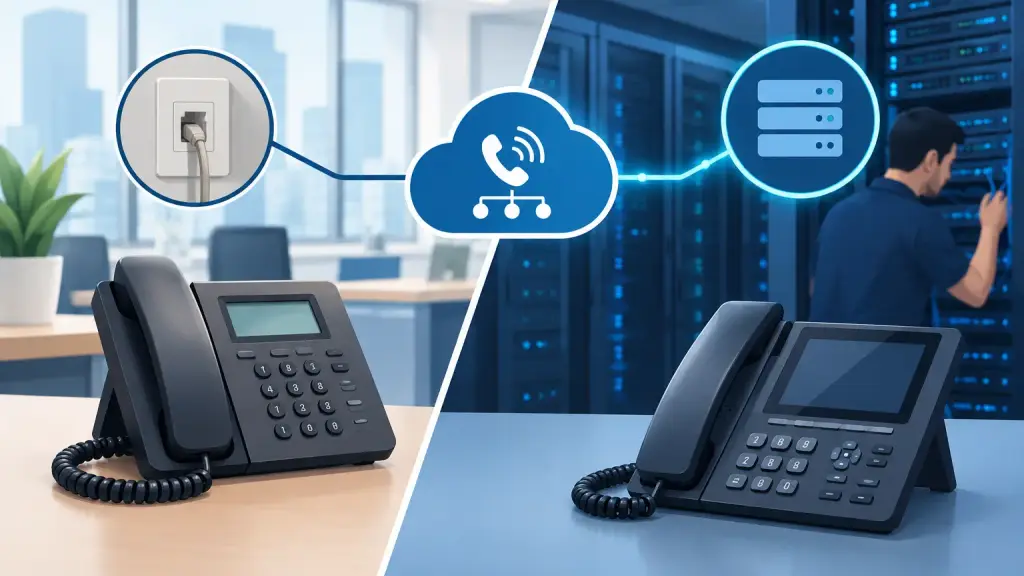
A busy office can feel a phone problem immediately. Calls fail to reach reception, customers hear ringing with no answer, and staff lose a primary way to schedule work or serve clients. The decision between analog lines versus SIP trunks affects more than the monthly phone bill. It determines how your business handles capacity, outages, future changes, and the equipment already installed at your location.
For Chicago-area businesses running established phone systems, the right answer is rarely a simple rule. Analog service may still support a specific business need well. SIP trunks can add capacity and flexibility without replacing every phone on day one. The practical question is which service fits your operation, your PBX, and your tolerance for disruption.
What Analog Lines Still Do Well
Analog business lines, often called POTS lines, use a dedicated copper pair for each call path. A one-line connection supports one active call. If an office needs four simultaneous calls, it traditionally needs four separate analog lines.
This setup is familiar, straightforward, and compatible with many older PBX systems, fax machines, elevator phones, alarm panels, and specialized devices. On a traditional copper circuit, a basic analog phone may continue working during a local power outage because the line provides its own power from the telephone network. That characteristic has long made analog lines useful for critical single-purpose applications.
For a small office with low call volume and a working legacy key system, keeping a limited number of analog lines can be reasonable. The equipment is already configured, staff know how to use it, and there may be no immediate operational reason to change it.
However, analog service has limits. Adding call capacity requires additional physical lines and available wiring. Finding a fault can involve the PBX, inside wiring, jacks, carrier facilities, or the line itself. Many carriers are also moving away from traditional copper infrastructure or delivering analog-style service through newer network equipment. That means an analog line may no longer have the same power-outage behavior or repair process it had years ago.
Analog Lines Versus SIP Trunks: The Core Difference
A SIP trunk carries voice calls over an IP connection rather than dedicating a separate copper pair to every call. SIP stands for Session Initiation Protocol, the standard used to establish and manage voice sessions. For a business, the key benefit is capacity. A SIP trunk can be configured for the number of simultaneous calls the organization needs, then adjusted as staffing or call volume changes.
SIP trunks can connect to an IP-PBX directly, but they can also work with many existing digital or analog PBX systems through the right interface, gateway, or programming. This matters for businesses with systems from Panasonic, Nortel, Avaya, NEC, Vodavi, and other established platforms. Replacing a functioning PBX solely to change the incoming service is not always necessary.
The trade-off is that SIP depends on the quality and design of the network carrying it. Voice traffic needs enough bandwidth, stable latency, low packet loss, proper quality-of-service settings, and reliable power for network equipment. A poor internet connection or improperly configured firewall can produce choppy calls, one-way audio, registration failures, or intermittent inbound calling problems.
SIP is not automatically better because it is newer. It is better when the network, equipment, call volume, and support plan are ready for it.
Capacity and Growth: Where SIP Usually Wins
Businesses often discover their analog limitations during the busiest part of the day. A medical office may have enough desk phones for ten employees but only three outside lines. A customer calling when all lines are occupied may receive a busy signal or be routed away. Adding capacity can take time and may require new cabling or carrier work.
With SIP, capacity is based on concurrent call paths rather than a bundle of physical lines. That makes it a strong fit for offices with seasonal volume, multiple departments, growing teams, or high inbound calling. It can also support direct inward dialing, so employees or departments can have individual numbers without assigning a separate physical line to each extension.
That flexibility should be planned carefully. Ordering far more call paths than your office can answer does not improve customer service. The correct capacity depends on peak call traffic, the number of staff available to handle calls, auto-attendant design, failover needs, and whether outbound calling is concentrated at certain times.
Reliability Depends on Design, Not Labels
Some organizations assume analog is always more reliable and SIP is always dependent on a fragile internet connection. Others assume moving to SIP eliminates every telecom problem. Both assumptions can create risk.
Traditional copper analog service has a long record of reliability, particularly when paired with simple analog equipment. Yet aging cable plant, changing carrier networks, and discontinued infrastructure can make repairs more difficult in some areas. If an analog service is being delivered through a terminal or network adapter, it may also require commercial power at the site.
A properly designed SIP installation can be highly dependable, but it needs deliberate planning. Network switches, routers, firewalls, modems, and PBX equipment should have battery backup. Voice traffic should be separated or prioritized correctly. Businesses should know what happens to inbound calls if their building loses internet access, and they should test that plan before an emergency.
For a critical location, redundancy may include a backup internet connection, call forwarding during a site outage, or a mix of services for specific devices. The best contingency plan is one that staff can use under pressure, not one that exists only in a configuration document.
Protecting Legacy PBX Investments
A legacy PBX is not automatically a liability. Many older systems remain dependable, familiar to users, and well suited to the way an office operates. The issue is whether the system can be maintained, whether replacement parts and expertise are available, and whether it can connect effectively to current carrier services.
There are several practical paths. A business may keep analog lines for a smaller system that has stable call volume. It may retain the PBX and add SIP connectivity through compatible hardware. Or it may migrate to a hosted VoIP platform when the current equipment no longer supports business needs, repair costs become unpredictable, or a multi-location operation needs more centralized administration.
Before making a change, an experienced technician should assess the PBX model and software version, current trunks and line cards, station wiring, voicemail, paging, door phones, faxing, alarm connections, and emergency calling requirements. These details often determine whether a migration is simple or whether it needs a phased approach.
A phased project can reduce risk. For example, a company may move primary voice traffic to SIP while retaining a limited analog connection for a device that cannot yet be converted. Once testing is complete and the remaining equipment has a workable solution, the business can decide whether to keep or remove the analog service.
Questions to Answer Before You Switch
The best telecom decisions start with an accurate picture of how calls move through the business. Before replacing analog lines or ordering SIP trunks, document four areas:
- Your busiest periods, current line count, missed-call concerns, and expected growth.
- The PBX make, model, age, available expansion capacity, and condition of its cabling and power protection.
- Every device that uses a phone line, including fax machines, alarms, elevators, credit card terminals, gate phones, and emergency phones.
- Your internet service, network layout, firewall, battery backup, and outage-routing plan.
Do not overlook 911 service. Whether you use analog or SIP, emergency calling must present the correct service address and route appropriately for your location. This is especially important for businesses that move offices, operate multiple locations, or use remote staff and hosted services.
When to Keep Analog and When to Move to SIP
Keeping analog lines often makes sense when they serve a specific low-volume purpose, the current PBX is stable, and the business does not need more simultaneous calls or advanced routing. They can also remain useful during a transition, particularly where specialized equipment has not yet been updated.
Moving to SIP is generally a stronger choice when call capacity is constrained, adding lines has become difficult, the company is expanding, or the existing service needs more flexible routing and number management. SIP can also be a logical bridge for organizations that want to preserve a working PBX now while creating a practical path toward hosted VoIP later.
The decision should not be made from a carrier sales pitch or a generic online checklist. It should be based on an on-site review of the phone system, cabling, network, and the actual consequences of a missed call. For businesses in Chicago and the surrounding suburbs, iTeleco can assess legacy PBX equipment, diagnose line issues, and help build a transition plan that keeps communications working while changes are made.
Your phone service should support the way your business answers, transfers, and recovers calls when conditions are not ideal. Start with the equipment and risks you have today, then choose the service path that gives your staff a dependable next step.