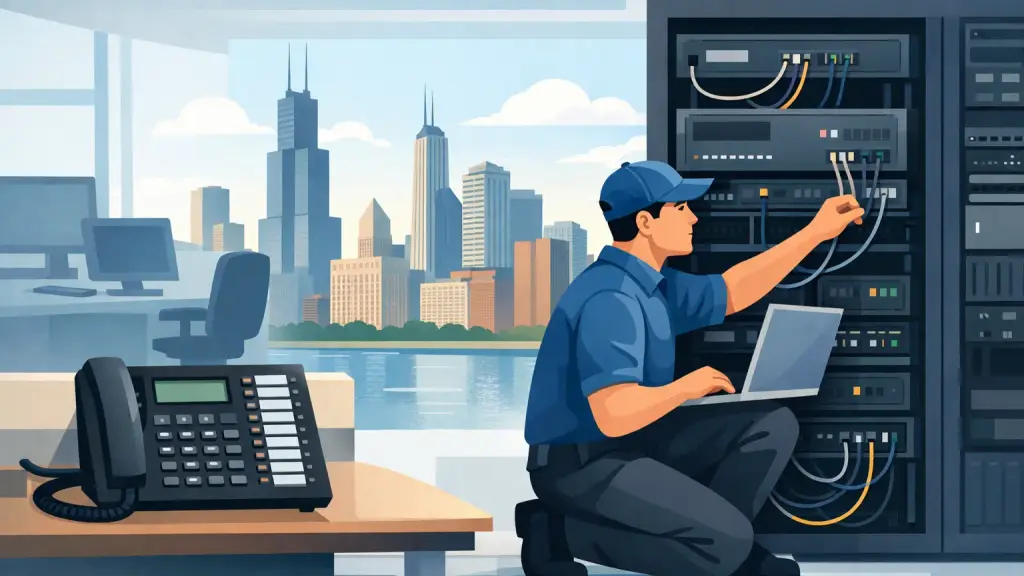
A Panasonic PBX can run reliably for years, until one failed card, power supply, voicemail issue, or programming change leaves your office unable to make or receive calls. When that happens, the question is not simply who repairs Panasonic PBX equipment. It is whether the technician understands the specific system, can isolate the actual fault, and can restore service without disrupting the rest of your operation.
For Chicago-area businesses still relying on Panasonic phone systems, the right answer is a business telecommunications provider with hands-on legacy PBX experience, access to appropriate replacement components, and the ability to provide on-site support when remote troubleshooting is not enough. A general IT provider may manage networks well, but PBX repair requires a different skill set.
Who Repairs Panasonic PBX Systems?
Panasonic PBX systems should be serviced by trained business phone system technicians who work with legacy telecom hardware, station wiring, trunks, voicemail, programming, and system cabinets. These are not consumer telephone repairs. The technician needs to understand how the entire phone environment works together, from the carrier handoff and network equipment to the PBX, handsets, paging, door phones, and voicemail.
A qualified provider can diagnose systems such as Panasonic KX-TDA, KX-TDE, KX-TAW, KX-NS, and related Panasonic business phone platforms. The exact repair approach depends on the model, its age, the cards installed, and how your lines and users are configured.
In some cases, the fix is straightforward: replace a failed power supply, reset a locked voicemail process, repair a damaged cable, or correct a programming error. Other problems require deeper testing. Intermittent call drops, phones that lose registration, static on selected extensions, or incoming calls that ring nowhere can point to several different causes. Guessing wastes time and can create a larger outage.
What a Panasonic PBX Repair Specialist Should Handle
The best repair provider does more than swap a part and leave. They start by determining whether the problem is inside the Panasonic system, with the phone carrier, in the cabling, or on a connected network device. That distinction matters because a PBX can appear to be at fault when the real issue is a failed trunk, a damaged demarcation connection, an aging battery backup, or a network configuration change.
A capable Panasonic PBX technician should be able to handle hardware diagnostics, extension and handset issues, trunk and line testing, voicemail troubleshooting, programming changes, cabinet cleanup, and replacement card installation. They should also be able to verify that the repair works under real business conditions, including inbound calling, outbound calling, transfers, paging, voicemail, and key department or hunt-group routing.
For organizations with multiple offices or specialized call flows, documentation is also part of a proper service call. A system that works only because one former employee understood its shortcuts is a risk. Clear records of extensions, voicemail settings, carrier connections, and installed components make the next repair faster and reduce dependence on tribal knowledge.
Common Panasonic PBX Problems That Need Professional Service
Some symptoms are obvious, such as a system that will not power on or an office where every phone has gone dead. Others develop slowly and are easier to overlook until they affect customer service or sales.
A professional should investigate recurring issues such as no dial tone on multiple phones, calls that cannot transfer, voicemail that does not answer, phones displaying errors, one-way audio, crackling lines, dropped calls, failed auto-attendant routing, or extensions that cannot call out. If a problem affects only one handset, the handset or its cable may be the issue. If it affects a department or the entire office, the cause may be a station card, trunk card, processor, power component, programming setting, or carrier connection.
Businesses should avoid repeatedly rebooting the PBX as a long-term fix. A restart can temporarily clear a condition, but it can also mask a failing component or cause additional issues if the system does not come back online cleanly. Before restarting equipment, record the symptoms, affected extensions, error messages, and the approximate time the failure began. That information helps the technician reach the right diagnosis faster.
Why Legacy Panasonic Experience Matters
Many Panasonic systems remain in service because they are stable, familiar to staff, and connected to existing cabling and business workflows. Replacing a working system solely because it is older is not always the best operational decision. If the hardware is supportable and your current calling needs are being met, targeted repair and preventive maintenance may be the most practical route.
The trade-off is that legacy systems require a provider that still understands them. Some vendors focus only on new cloud platforms and may recommend replacement before fully evaluating repair options. Modernization can be a smart move, particularly when a business needs remote users, easier multi-site management, better mobility, or a predictable path away from aging hardware. But it should be a business decision, not a rushed reaction to a problem that may be repairable.
An experienced PBX specialist can explain both paths clearly. They can repair the immediate failure, identify components that may become difficult to source, and help determine whether continued maintenance or a staged transition to hosted VoIP makes more sense for your organization.
When to Call for Emergency Panasonic PBX Repair
Treat a PBX issue as urgent when it prevents customers, patients, vendors, or employees from reaching your business. Total loss of incoming or outgoing calling, widespread phone failure, an auto attendant that sends calls to the wrong place, and a system outage after a power event all warrant immediate attention.
The same is true when a partial failure affects a revenue-critical team. A few inactive phones in a sales department, front desk, dispatch office, or service center can have a measurable impact even when other extensions still work.
When calling for emergency service, be ready to provide the Panasonic system model if known, the number of affected phones, whether calls fail inbound or outbound, recent power or construction events, and any visible alarms or error messages. Do not remove cards or change programming unless guided by a qualified technician. PBX cabinets contain components that must be handled carefully, and an incorrect change can turn a limited issue into a larger one.
Repair, Maintenance, or Replacement: How to Decide
The right choice depends on the condition of your Panasonic PBX and the goals of the business. Repair is usually sensible when the issue is isolated, the system remains stable after testing, replacement parts are available, and the platform still supports your daily call flow. Preventive maintenance can extend that value by addressing weak batteries, poor cabinet conditions, unmarked wiring, unreliable handsets, and undocumented programming before they create downtime.
Replacement deserves consideration when failures are recurring, critical components are no longer practical to support, the company has outgrown the system, or your teams need features that the existing platform cannot provide. Hosted VoIP can reduce dependence on on-site PBX hardware and make expansion easier, but it also requires planning around network readiness, call routing, user training, and any devices that must remain connected.
For many businesses, the best answer is neither an immediate replacement nor indefinite repair. It is a planned transition. Keep the existing Panasonic system operating reliably, document the environment, and move on a timeline that protects service continuity.
Local Panasonic PBX Support for Business-Critical Calls
A phone system failure is rarely convenient. It tends to happen during the busiest part of the day, after a power issue, or when a staffing change exposes a programming problem nobody documented. That is why local, fast-response service matters.
iTeleco provides Panasonic PBX repair, maintenance, programming, cabling, relocation, and 24/7 emergency support for businesses in Chicago and surrounding suburbs. The goal is straightforward: identify the fault, restore communications, and give your business a clear recommendation for keeping the system dependable.
If your Panasonic PBX is failing, do not wait for a small calling problem to become a full outage. Have the system evaluated while there is still time to protect your customers, your staff, and the calls your business cannot afford to miss.